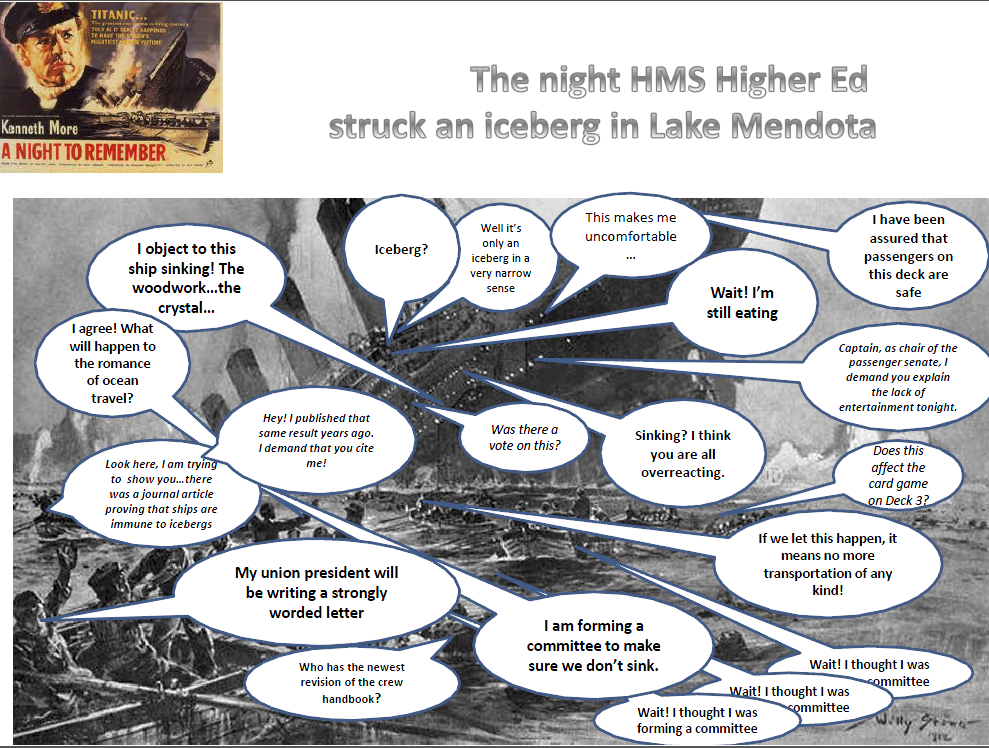
Today’s WSJ article about the announcement from the University of Wisconsin about a completely online degree is generating a lot of online comment and discussion. Here is how I would characterize the conversation so far. Click on the image for a higher resolution version.
When I wrote Dancing with the Stars of Pure Math the idea of attending Dick Lipton’s seminar with 10,000 students was novel and risky. That was 2009. Well before the start of the innovative whirlwind in online education that was started when Sebastian Thrun, Daphne Koller and Andrew Ng opened their Stanford courses to hundreds of thousands of students.
Dick and I spoke with Sebastian before Udacity was launched and we were both impressed with his vision of the learning experience as compelling media. As best I can recall, here is what he said.
If the traditional lecture is a stage play, then I want to be the movies. Although early film makers tried to adapt live stage plays to the new media by pointing a camera at the stage, it was not a good experience. It was only when film makers realized that they had to recreate the dramatic form that film became a new and compelling experience.
In his recent post at Godel’s Lost Letter (GLL), Dick has given us a vision of a new form of instruction:
The usual video-based course is a film of an instructor talking and writing at a board or on a tablet computer. These courses are popular among students, at least partially because they are free. The videos are informative, although it is yet unclear whether they are as good or better than physical courses. You know—course with students in seats and an instructor talking and interacting with them. We will see…Our plan is to make a mini-series length course with characters who have issues, who follow an interesting story line—vampires?—and yet are able to convey the information we want the students to learn. Our view is to create a new type of film: not a documentary, not a docudrama, not a dry lecture. A mixture of fiction and information.
This is unabashedly an experiment. I have been trying to find a way to incorporate GLL into our online experiments at Georgia Tech, and this is a a prototype of how that might work.
What do you think? Will students go to the movies with stars of pure math?
What other formats do you think might work? I have been (unsuccessfully so far) lobbying Dick and Ken to try what I call The Larry King Show format. In this format the host (Dick or Ken) and maybe a sidekick talk about math by interviewing math celebrities (including the people who created the ideas). They can even “interview” celebrities who are dead by using actors and inventing plausible dialogues.
Larry King was famous for his “Hello, Duluth Minnesota!” call-in dialogues, and that part of the show seems to me to be ideally suited to a seminar. There might even be some surprise call-ins when the topic is (for mathematicians) controversial.
You have to get used to the idea of classrooms as performances.
Today’s commentary at the John William Pope Center for Higher Education Policy leads off with my article about where accreditation is heading.
Accreditation is an idea that makes sense if you think of universities as factories:
Accreditors were supposed to be the quality control department of the factory.
That factory model is crumbling, however, shaken by new technology. This is the “Year of the Massive Open Online Course” in which technology-enabled teaching to global classrooms of 100,000 students has been the subject of feverish coverage by virtually everyone with an interest in the dire condition of American higher education.
MOOCs may be an over-hyped fad, but the educational landscape has been forever changed.
Change will revolve around outsized characters like Stanford’s Sebastian Thrun and Daphne Koller. They are the whiz-kids whose weekly inventions incite great thoughts about what college might become.
Accreditation is, well, boring. Accreditors are the green eye shade players in the drama of higher education. It’s hard to get excited about green eye shades, buttoday—improbably—I find myself excited by accreditation. To bemore exact, I am excited about what will replace it.
This is an era in which the value of credentials is being reexamined, and the focus of quality assurance is shifting from institutions and programs to individuals and personalized, lifelong educational experiences. Traditional accreditation — costly and largely ineffective — must certainly adapt or risk being marginalized.
In last year’s edition, ACTA followed the curricula at over 1,000 undergraduate institutions to see whether there was any correlation between desired learning outcomes in liberal arts programs and topics actually covered in the classroom.
Last year’s results were shocking enough.
Most high-tuition institutions — including the Ivies — failed to provide even the most basic coverage of topics promised in published course descriptions. You would think, for example, that a humanities curriculum that promises courses in the sciences and mathematics would design courses in which students could actually learn both science and math. No so, for a shocking percentage of the institutions who ask students to pony up $40,000 per year for the experience of bypassing pretty much every useful mention of physics, chemistry, biology, algebra, and computer science.
This year’s survey results were no more encouraging: From the report’s Executive Summary:
What Will They Learn?™ evaluates every four-year public university with a stated liberal arts mission as well as hundreds of private colleges and universities selected on the basis of size, mission, and regional representation. All schools in the What Will Will They Learn™ study are regionally-accredited, non-profit institutions. Combined, the 1,070 institutions in the What Will They Learn?™ study enroll over seven million students, more than two-thirds of all students enrolled in four-year liberal arts schools nationwide.
Overall, the results are troubling. The grade tally tells the story:
A 21 (2.0%)
B 393 (36.7%)
C 338 (31.6%)
D 229 (21.4%)
F 89 (8.3 %)
Less than half of the schools studied require:
Literature – 37.9%
Foreign Language – 13.7%
U.S. Government or History – 18.3 %
Economics – 3.4 %
The Seinfeld Show
Most discouraging to me is the F grade that Amherst earned this year by requiring literally nothing. Sacrificing at the altar of curriculum flexibility, Amherst has no core requirements. This leads to an extremely high completion rate with no guarantee that a student knows anything at all about math, reading, history, or composition. It doesn’t have to be that way; you can dispense with a core curriculum and not sink into the academic version Jerry Seinfeld’s “show about nothing.” [See, for example, my chapter on the Threads curriculum in Abelard to Apple].
PCAST to Release Report on Future of the Research Enterprise. On Friday, November 30, the US President’s Council of Advisors on Science and Technology (PCAST) will hold a meeting to discuss IT R&D, STEM Education, and Online Courses (see agenda (PDF)). In addition, it will release a new report entitled Transformation and Opportunity: The Future of the U.S. Research Enterprise. The report will address “specific opportunities for the Federal Government, universities, and industry to strengthen the U.S. research enterprise.”
Date: November 30, 2012
Time: 1:30 – 3:00 p.m.
Location: Lecture Room of the National Academy of Sciences Building, 2101 Constitution Avenue, NW , Washington, D.C.; Register to attend this public event here.
Resetting the bar: comment from a World Economic Forum Council member in Dubai after following some MOOCs and listening to Daphne Koller’s impassioned presentation,
Now I get it. This is the death of mediocre teaching.
Up for discussion
Change
Institutional roles
The university versus education
The impact of technology
The changing nature of students
Global agreement vs. Disconnect:
Agreed: Education has a role
Confusion: Relevance of institutions
Scary concept of the day: “Global Governance” Former PM Gordon Brown hammered this home. The last thing we need is a European-style bureaucracy to act as a gate-keeper for higher education.
Why is social innovation grafted onto the margins of institutions of higher education? (Note: Where are the liberal arts in these discussions? See my blog post about the not-so-liberal arts)
Complex coupling of learning and value in many cultures – there is no American-style consensus about that this means (more about “Social Contracts and the Global Wisconsin Idea” another day — but see my discussion of The New Wisconsin Idea in Abelard to Apple).
What is the role of access when all content is accessible?
Global reactions to MOOCs (discouraging variety)
President of a THE top ranked research university.
That is not a role that my institution is interested in undertaking. There is a certain class of institution that may be interested, but it is certainly not our class.
Another president:
We would be just as happy with no students at all
Faculty member (no institutional affiliation):
Neither I nor my colleagues have the slightest interest in this [online technology]. If it is not related to my research I am not interested
Faculty member (no institutional affiliation):
There are no rewards for this
Expert in emerging technologies:
This has no relevance to me or my work.” [This is related to the debate over institutional relevance]
Global Reactions to MOOCs (encouraging variety) from Ed Lazowska, University of Washington:
The biggest change I see is that everyone on campus is talking about education and teaching. At a research university that is a big deal.
Big Idea of the Day – Privacy Risks from Learning Analytics
As more fine-grained data is gathered and stored in the Cloud privacy risks spike.
Most legislation in the US predates the internet and GMailWhat are some of the risks? Learners can be tagged with damaging labels because of their trajectory through online courses: “slow learner” vs “smart” even though the labels have no relationships to learning outcomes.
Electronic Communication Act of 1986 – much lower standard for investigators than wiretaps
Warrant for unopened email
Much weaker standard (e.g., relevance) for
Documents stored in the cloud
Opened email
Archived email whether read or not
Role of FERPA
What are the unique risks posed by Big Data
Information from many sources can be combined by investigators
There are incentives for more data and longer retention times
Users are not aware of how much data is being collected
Information playing field is tilted toward large institutions (e.g., states, corporations)
Amplifies advantages and disadvantages
“Capricious” use of stored data
Insurance
Credit worthiness
Law enforcement
What can analytics reveal that violate reasonable privacy expectations?Without sharing, learning analytics data is not very useful, so we should assume that sharing will occur.
Failures
Past Associations
Mental Instability
Financial History
Behavior of acquaintances and family members
Personal indiscretions
Social Security Number and other protected identifiers
Legal proceedings regardless of outcome
It is beyond the state of current technology to share private data from learning analytics while simultaneously
Limiting disclosure
Ensuring data utility
Jeff Selling writes in CHE: College Presidents Tone Deaf on Value:
Whatever tools we settle on, the efforts to measure value start at the top of the institution and the groups that represent higher education. And right now, college presidents are either tone deaf to the concerns of the public or they don’t believe in their own product.


 Innovate.EDU