vigilantes360

It dawned on me during the recent saloon brawl at the University of Texas over exactly when and on whose terms President William Powers would leave office that the nation’s top research universities could succumb to the rule of self-interested and unaccountable mobs. Texas joins a growing list of public universities where governing boards have tried to remove presidents—one of the few duties that virtually every state assigns to boards—only to find themselves demonized as cabals. It can’t be a cabal if you are the public authority designated to make those decisions. What began in 2012 as a media spectacle–triggered by the short-lived firing of University of Virginia President Teresa Sullivan and fueled by Twitter and Facebook campaigns worthy of Tahrir Square—has become trendy as the number of legitimate governance decisions undone by academic vigilantism has tacked alarmingly upward.

The Texas case is notable because there is pressure coming from two directions. Heavy-handed political influence from conservative allies of Governor Rick Perry, who are unconvinced of the need for a research mission at UT-Austin and want the university’s Board of Regents to force the flagship university to abandon—or at least starve—it, has so damaged the board that one of them is under investigation for possible impeachment. On the other side, faculty and student groups who want Powers to stay have taken to the media to build public support for their case. Many of them were attending a symposium about online education when a deal that would allow Powers to remain in office was announced. The ensuing celebration was boisterous and probably helped the cause of those who are demanding the impeachment of Perry’s allies.

The dust-up with the Texas Board of Regents is only the most recent example of how difficult university governance has become. Even unremarkable commencement ceremonies came under assault earlier this year as a dozen high-profile speakers were disinvited by university administrators who bowed to pressure groups. What could have riled the unruly mobs? Among those who threatened the sensibilities of the Class of 2014 were IMF Director Christine Lagarde and a critic of radical Islam who had survived mutilation in fundamentalist Muslim East Africa. All were excoriated in public. Faculty groups, student newspapers, bloggers, and anti-defamers rose up in protest that views so divergent from their own should be expressed under a banner proclaiming truth or veritas, or something like that.

So much for academic diversity and the fearless band of heroes and martyrs that, Daniel Coit Gilman, the first president of Johns Hopkins—the first American research university—promised would “prosecute learning” regardless of consequences. It is probably not what John Adams had in mind in 1780 when he wrote in the Constitution of the Commonwealth of Massachusetts of the moral duty of society to cherish the interests of “seminaries of learning.” It does not cherish their interests to pay attention to the digital-age equivalent of epithets scrawled on subway walls. But that is what, increasingly, masquerades as academic governance. Unchecked, it is a trend that imperils ours, the best universities in the world.

Religious institutions aside, there are really only two ways to run a university. In Europe, universities are state-run affairs. Professors are civil servants, and Ministries of Education make all of the important decisions. University presidents and other administrators are chosen in faculty elections, but they are in truth labor leaders who are beholden to the narrow interests of professors, not to students or even to society. The sorry state of European research universities (despite a five hundred year head start, only eleven of the top fifty research universities in the world are European; thirty-one are North American) is a testament to the failure of that model.

American universities (especially public universities) were conceived differently with appointed trustees or regents who are accountable to society. In the U.S. system, boards have ultimate legal authority to choose top administrators, approve faculty appointments and guarantee academic freedom. Presidents are then given considerable autonomy in the day-to-day running of their institutions. That autonomy is shared with faculty members who are expected to make expert decisions about academic matters in a system of governance outlined in a 1915 declaration of academic freedom that marked the founding of the American Association of University Professors (AAUP). Autonomy is so ingrained that shared governance is sometimes willfully–almost comically–misconstrued to mean that administrators work for the faculty and that governing boards are at best irrelevant to a university’s mission.

In normal times it probably does not matter much, but these are not normal times. Forty million Americans owe 1.2 trillion dollars in student loans. One in seven borrowers defaults within two years of leaving college. Tuitions are rising at twice the rate of inflation while family incomes are flat. Americans have lost confidence that affordable, excellent college education is within their reach. Under pressure from both the left and the right, political correctness has become a bludgeon used to beat back the free exchange of divergent views on campus. Change is needed, and there are transformational ideas that can help universities get back on track. But, as former University of Michigan President James Duderstadt has pointed out, change will be slowest at the institutions where shared governance is strongest. The mobs could care less.

Who has the interest of society uppermost? Presidents are accountable, but most have careers to advance. They have powerful incentives to behave like stewards of the status quo. Not faculty. Many are deluded about the need for someone to be in charge at all. Not students themselves. They have even narrower interests and lack perspective. The AAUP’s 1915 declaration acknowledges that governing boards are responsible for society’s interests. Not all boards are good at that, and the bad ones should be replaced. It is not clear what led to the Texas Regents’ decision to fire William Powers. Conflicts with trustees can simmer for years before boiling over and leading to a president’s ouster. The publicly stated rationale for a firing is not always the real one, but Governor Perry’s fascination with a shortsighted agenda promoted by the conservative Texas Public Policy Foundation certainly played a role. As bad as those ideas would be for a great university, it is hard to argue that the long-term interests of institutions like the University of Texas are served by polling unaccountable mobs.

College presidencies are derailed all the time. There were dozens of firings last year. Hundreds of people who represent unpopular points of view made commencement addresses. So why such a ruckus over a Texas firing or Christine Lagarde’s commencement invitation from Smith College? Mobs have become well-heeled Internet marketing experts. It is no accident that supporters of William Powers were in contact with Teresa Sullivan’s supporters at The University of Virginia, where the art of demonizing and isolating board members was perfected. It is only a matter of time before roving bands of torch-waving villagers realize that by storming the gates they can impose their interests and the well-armed mobs start roaming the Halls of Ivy.

The result will be the steep descent of the best American universities into a soup of international mediocrity when global leadership is needed. The contract between academia and society is strong in this country. It was renewed in President John Bascom’s 1879 “Wisconsin Idea” that spoke of the university’s duty to reach into every family, and Rafael Reif’s soaring 2013 MIT inaugural that warned of the dangers to society of driving an economic wedge between universities and the American public. It is diminished every time a mob is rewarded for undermining legitimate authority. Universities are a national treasure to be cherished, and strengthening the quality of their governing boards also strengthens the social contract. Mobs like to attack strong boards as corporatist, but there is nothing corporatist about acting to ensure that institutions are healthy and vibrant. There is no sport in using Twitter to amplify personal attacks on trustees and administrators. It is a celebration of mob rule.

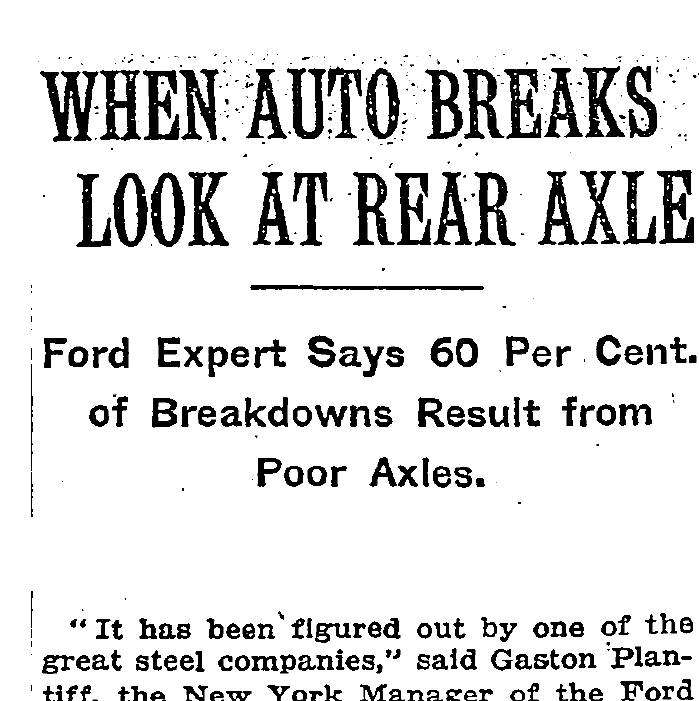
NYT Rear Axel 1912

I returned from eight months in Qatar in May and spent the next few weeks wrapping up the manuscript for my new book Heroes and Martyrs: How A Small Band of Innovators will Remake Higher Education. Doha made an interesting hilltop for observing and writing about American higher ed. In many ways the wealthy Persian Gulf nations have not changed much over the last hundred years.  Their massive investments in the knowledge economy may still pay off, but it will be a steep climb for societies that value membership in privileged tribal groups over actual achievement.

Meanwhile, the pace of change here is accelerating. Zealots love the idea of rapid innovation, but there are real and imagined roadblocks–and a lot of people who are trying to disentangle the two. It would be a shame to declare today that technology-enhanced education is doomed because of a barrier that may be irrelevant tomorrow. Or worse yet, because success might be bad for professors.  In short, it seems to me pretty early in the innovation cycle to be declaring–as University of California President Janet Napolitano did last week–that a roadblock is insurmountable.  She was talking about MOOC’s, but her critique was a repackaging of objections to educational technology that have been repeated so many times that casual observers might confuse them with established fact.  Maybe it’s just a result of living in the Middle East, but I hear in domestic  arguments about the future of higher ed more than a little tribal talk about what is good for professional academicians.

I was keeping this 1912 New York Times article as a reminder of how far off base preliminary assessments of what’s feasible can be–especially when underlying technologies are being transformed. Ford’s use of lightweight Vanadium steel for axles gave it an insurmountable advantage until drive train technology made  modern suspension systems possible. It’s a morality play. Higher education is in the the early days of a technology-enabled revolution. So early that no one should be trying to tie breakdowns (yes, there are breakdowns) to intractable root causes. I tried a different approach in my new book.

Jaws-jaws-468738_1024_782

The “Year of the MOOC” is really over. Now that 2012 is behind us, many seem to be hoping that the hype about MOOCs has faded. The reality of coping with producing new kinds of courseware has set in across many campuses. Coursera — already the grand elder — is holding a partners conference this spring that will attract hundreds. The major MOOC providers already have stakeholders. It is a sign that things are calming down.

Other signs are more tangible. I have heard from presidents who are returning to their comfort zones:

I want to raise the rankings of all my programs to Top 20

Or, the even more popular,

My faculty is too focused on its research to…[insert almost anything not directly related to research]

In fact, the more prestigious  the research program the louder is the sigh of relief that things will quickly return to normal.

The specter of immediate budget cuts has faded, so extreme measures are no longer necessary to guard us from the dangers that seemed to be looming just offshore six months ago.

This year’s reports on the financial health of public and private institutions show that the failure rate has ether plateaued or entered a kind of emotional stasis in which it is possible to believe:

The world will always need [insert the name of any of the 1,000 schools that offer unrealistically discounted tuition to keep its enrollments stable].

Fueled by tuition increases and the benefits of prior cost-cutting, hiring has picked up.  Private donations are also on the rise some places. Long-delayed capital improvement projects have restarted.  Most importantly, faculty members have simply stopped worrying about it.

I’m feeling like Jaws’  Captain Quint warning all the Fourth of July beach-goers,

This shark he swallow you whole.

There are are many more Mayor Vaughns who take at the ups and downs of academic fortunes in stride and look for ways to sooth the worried townsfolk:

…it’s all psychological.  You yell barracuda, everybody says “Huh?  What?” You yell shark, we’ve got a panic on our hands….

I guess we overreacted.  It’s safe to go back in the water.

That’s why Moody’s 2013 outlook report on the future of higher education should be such a shock to the system:

The 2013 outlook for the entire US higher education sector is negative, including the market-leading, research-driven colleges and universities, says Moody’s Investors Service in its annual industry outlook. Previously Moody’s had a stable outlook for these leading institutions and a negative outlook for the rest of the sector since 2009. Moody’s perceives mounting fiscal pressure on all key university revenue sources.

It’s not safe to go back in the water. This shark he swallow you whole:

Even market-leading universities with diversified revenue streams are facing diminished prospects for revenue growth

Almost everyone else will see declining enrollments as prospective students become more price sensitive.  A Huffington Post article reports on a separate survey of 300 colleges and universities that shows a dramatic drop in the number of institutions expecting to see rising revenues.

In addition to concerns about student debt, revenue uncertainties and the public perception of value, Moody’s sees the potential for disruption by technologies like MOOCs. Chaos has not left the scene, and as Moody’s points out, structural changes — whether technology-enabled or not — are necessary in order to survive. Far too few leaders are willing to even discuss what structural changes might look like.

I spoke to a gathering of presidents and provosts about this last week.  Presidents of research universities were noticeable absent, although they sent a few worried deans who see the coming challenges. Presidents are the only ones who can make the scale of changes that are needed, but they must believe in their hearts that “it’s all psychological”

Backer Jacob  envy

The next verse of the epic poem “Year of the MOOC” will almost certainly be a recounting of a fall from grace if I am correctly reading my recent discussions with dozens of institutional leaders. Whether there will be enlightenment and ultimate redemption is less clear at this point, but what should be a path forward for thousands of institutions could just as easily lead to despair and ruin.

Not because MOOCs are a bad idea, mind you. If there were ever a confluence of innovations that could perfect learning, the simultaneous maturing of  MOOCs, social networking,  and big data are it.  Daphne Koller makes the point in her now ubiquitous Coursera speech: We have known for thirty years (since Benjamin Bloom’s landmark paper “The Two Sigma Problem”) that the master classroom is a way to universally improve learning when compared to traditional classrooms.  The only thing holding us back was the cost of personalizing the learning experience for each student.  MOOCs allow master classrooms be operated effectively for large numbers of students.  I just spoke with edX’s Anant Agrwawal, and he cites a half-dozen other research results confirming better learning enabled by MOOCs.That’s the innovation, and that’s what makes MOOCs such a great idea.

The very existence of MOOCs could be a pathway to think about value in a new way, to looking at the constraints that existed before Udacity, Coursera, and edX and wondering what the next world would be like. It may not turn out to be paradise but it will be a world without those constraints. Instead, too many institutions are reverting to the seven deadly sins of higher education.  Beginning with envy.

In Abelard to Apple I blamed envy for many poor decisions by otherwise insightful academic leaders. Higher education has opted into a destructive, needlessly competitive class system in which schools at the top of the hierarchy are chased by everyone else in a rigged game that ultimately hurts students. If you are a state school, you envy one of the famous public research universities. Technical universities envy MIT and CalTech, Liberal arts colleges envy whichever institution is  at the top of the pyramid whose riches they covet. It is institutional envy pure and simple.  It has been the ruination of hundreds of otherwise promising colleges and universities and has helped drive American higher education to the brink of unsustainability.

Here is an excerpt of my recent conversation with someone in a senior leadership role at a college — in the Middle to use Abelard to Apple terminology —  that is beginning to produce its own MOOCs:

Q: Why are you producing your own MOOCs?

A: Why should we let [deleted] do all the MOOCs? We are just as good as them. Why let them get all the credit?

There are a lot of reasons why this is a bad idea, but the common thread is that this school is trying to buy its way into a game that is rigged against them.  At the very least they will spend a lot of money (that they do not have) to produce a lot of MOOCs (that are not very good).  Yes, there will be a few that are really great, but those few do not justify the level of spending they are thinking about.  Most importantly they will fail because they have defined success as enrolling 100,00 students or more. Why is this an important number:  because [deleted] enrolls 100,000 students in its courses.

It’s a small leap to consider the effect of other deadly sins:

  • Lust: “100,00 students?  Wow!”
  • Gluttony: “I want them all”
  • Greed: “That should be worth a lot of money.”
  • Pride: “No one can do it better.”

There is no agreement on the the sins that belong on the list. I took theology courses from Thomistic scholars who had a decidedly medieval view of these matters. Aquinas for example was not a big fan of including sloth (“I don’t have to teach?”)  in the list preferring instead to go for a more popular malady afflicting monks who spent their lives in prayerful isolation (“I am so tired of dealing with unprepared, unmotivated undergraduates”).

Nor is there agreement on how tightly bound together these things are.  Can you have envy without pride?

Who is virtuous in this new world? At the risk of promoting unwanted scrutiny, I would have to say that San Jose State University is doing the right thing.  San Jose State decided to conduct an experiment in blended learning using the edX version of the MIT 6.002 course entitled Circuits and Systems. It could not have been an easy choice.  SJSU faculty had to sacrifice their hallowed position on the stage and redefine their roles in the classroom:

SJSU students have been viewing and using online materials as homework, including lectures, quizzes and virtual labs available through the edX platform. Then they go to class to work through problem sets with their instructor, thereby flipping the conventional approach of lectures in class and problem sets at home.

Initial reports are encouraging.  A course that historically flushes out 40% of the enrolled students in the traditional format, retains 90% in the flipped format.  Professors and students alike had to adjust, but maybe that is the price of virtue.  It is a price worth paying, because simply lusting after the 100,000 students is not a strategy that will be rewarded in this pre-MOOC world  or the next.