There’s a kerfuffle on the eve of the United Nations Climate Change Conference in Copenhagen. 1,700 email messages that were supposed to be stored on a secure server somehow found their way to open servers and were rapidly picked up by bloggers and others, who jumped on the opportunity to use the sometimes embarrassing messages to discredit the overwhelming consensus of climate scientists that the earth is warming at an alarming rate and that human activity is the most likely cause. Aside from the shocking coincidence of events — what are the chances that a massive, worldwide fraud would be exposed at the same time the conspirators are getting together to impose their new world order? — and the uproar among climate scientists — who are launching ad-hominem attacks at every skeptic who pokes his head above ground — are there other lessons to be drawn from this shameless bit of theater? My Georgia Tech colleague, climate scientist Judith Curry, hit the nail on the head when she pointed out that: (1) there is really nothing in the released messages that discredits published scientific results and (2) scientists are being incredibly counterproductive by retreating into their Ivory Towers and passing up the opportunity to educate and engage both skeptics and the public. Her Open Letter to Graduate Students and Young Scientists should be required reading for everyone interested in how to keep worlds from colliding:
…even if the hacked emails from HADCRU end up to be much ado about nothing in the context of any actual misfeasance that impacts the climate data records, the damage to the public credibility of climate research is likely to be significant. In my opinion, there are two broader issues raised by these emails that are impeding the public credibility of climate research: lack of transparency in climate data, and “tribalism” in some segments of the climate research community that is impeding peer review and the assessment process.
For “climate science” you can substitute “innovation” and the message is the same. If you’ve circled the wagons and are shooting at anything that moves, the easy target is public understanding of not only science but innovation in general. The American public is not interested in the long-term thinking required to make sense out of squabbles like this. There are simply not enough people like San Diego Florist Steve Boigon, who — according to the New York Times — downloads MIT physics lectures because he finds that:
I walk with a new spring in my step and I look at life through physics-colored eyes.
Curry did not go after the easy targets. Instead, she talked honestly to students about the importance of climbing down from the Ivory Tower. The interactive relationship between basic science, technological innovation and public policy — what Donald Stokes calls Pasteur’s Quandrant — is a hot topic these days, because so many important societal issues can only be resolved at their intersection.
There’s a veil that conceals the inner workings of creative science and engineering from the lay public, and attempts to lift it sometimes produce bizarre reactions. I was once struck speechless at an all-hands meeting when one of my engineers stood to scold the CEO for making product decisions because he knew “nothing about electronics.” A prominent member of my Board of Advisers at the National Science Foundation once countered criticism of his particularly cumbersome approach to software development by angrily proclaiming, “Programming is like playing a piano. Only virtuosos should do it!” A world-renowned engineer once responded to an essay critical of his methods by widely distributing a letter entitled “On a Political Pamphlet from the Middle Ages.” I was one of the young authors who was at the receiving end of that one. When outsiders try to lift the veil, the best course is to repair to the upper reaches of the Ivory Tower, hope that the hubbub goes away, and shoot down if it doesn’t.
It is a world view that is somehow wired into university training. The Medieval regalia, semi-religious icons, and murmured incantations that convey special status on the conferees reinforce the impression at every college commencement that something mystical has taken place. Science textbooks are uniformly silent on how science is done, presenting instead the subject as a linear, completed work — orderly in progression and tidy in its use of knowledge. Nearly every engineering textbook guides readers through well-rehearsed exercises to successful completion of design tasks. Why would anyone want to learn how to build a bridge that falls down?
Insiders, of course, know differently. What takes place behind the curtain is as important as the finished product. Some of the best technical books ever written lift the veil. Proofs and Refutations by Imre Lakatos describes the centuries-long frustration of mathematicians trying — and repeatedly failing — to precisely define polyhedra. The process led some of the greatest mathematical results of all time. Why Buildings Fall Down by Mario Salvatori and To Engineer is Human by Henry Petrosky are both compelling arguments that progress in engineering is inextricably tied to understanding engineering failure. Insiders know that failure is part of the package. That’s exactly what makes the most outrageous of the climate change attacks so improbable.
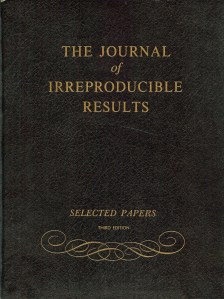
There is a sub-genre of humor devoted to obvious, boundlessly incompetent scientific failure, real or imagined. The Journal of Irreproducible Results is perhaps the defining publication that holds technical vanity up to ridicule. An article entitled Peaceful Use of Nuclear Explosives helpfully noted that
Development of hydro power in the desert of North Africa awaits only the introduction of water
My personal favorite medical discovery was an announcement entitled The Incidence and Treatment of Hyperacrosomia in the United States:
Some very famous Americans have indeed been afflicted with Acute Hyperacrosomia, among them Abraham Lincoln, George Washington and Lyndon Johnson. Their condition is readily apparent upon comparison with normal individuals such as Napoleon Bonaparte, Truman Capote and Dick Cavett…..Since the male population does express the condition to a higher degree, it falls primarily to the female population to objectively consider the risks of involving themselves with hyperacrosomic males…
The jokes are so well-known that Henry R. Lewis apparently had not second thoughts when he wrote The Data Enrichment Metho d:
The following remarks are intended as a non-technical exposition of a method which has been promoted (not by the present author) to improve the quality of inference drawn from a set of experimentally obtained data. The power of the method lies in its breadth of applicability and in the promise it holds in obtaining more reliable results without recourse to the expense and trouble of increasing the size of the sample of data.
I have a hazy understanding of the data manipulation charges that climate skeptics are leveling at researcher, but I am pretty sure that The Data Enrichment Method was not involved. There is also the issue of transparency that is specific to climatologists, but Curry handles that well. And then there are the charges that editors of journals were unduly influenced by political considerations. Like the Inspector in Casablanca, I would be shocked — truly shocked — to hear that hundreds, perhaps thousands, of smart, educated, and highly ambitious people make decisions based on self-interest. The secret that Curry reveals is that it may be regrettable, but it doesn’t matter in the long run. Science is not an orderly, axiomatic progression of knowledge. It is a social process.
Even a brief peek under the veil would be enough to convince many fair-minded skeptics that if there were another, compelling, contradictory analysis of the same data, it would have by now appeared in a reputable scientific journal. Why? Because it would be a career-making result. The article would write itself. What editorial board could long resist publishing an epochal article? History teaches that political manipulation is much more likely to focus on who gets priority as multiple groups rush to publish simultaneously. It’s a to maintain a conspiracy when everyone is looking out for himself. None of this means that everything that has been published is correct. It just means that it’s very unlikely that the shrill cries of systematic fraud have any validity.

So strong is the urge to seek out systematic scientific fraud, that there is a magazine devoted to the subject. The Skeptical Inquirer (SI) is a kind of companion to The Journal of Irreproducible Results. It specializes in debunking academic myths and scientific hoaxes. It has over the years exposed magicians, perpetual motion charlatans, creationists, and hundreds of scientific frauds. Who are these crusaders? They are the very power brokers that would have to be co-opted if the climate change conspiracy theorists were right. Here’s a partial list of SI Fellows:
- James E. Alcock <http://www.cicap.org/congress/alcock.html> ,* psychologist, York Univ., Toronto
- Marcia Angell <http://www.hms.harvard.edu/dsm/WorkFiles/html/people/faculty/MarciaAngel.html> , M.D., former editor-in-chief, New England Journal of Medicine
- Stephen Barrett <http://www.quackwatch.com/> , M.D., psychiatrist, author, consumer advocate, Allentown, Pa.
- Irving Biederman <http://geon.usc.edu/%7Ebiederman/> , psychologist, Univ. of Southern California
- Susan Blackmore <http://www.susanblackmore.co.uk/> , psychologist, Univ. of the West of England, Bristol
- Henri Broch <http://www.unice.fr/zetetique/> , physicist, Univ. of Nice, France
- Jan Harold Brunvand <http://www.janbrunvand.com/> , folklorist, professor of English, Univ. of Utah
- Mario Bunge <http://www.mcgill.ca/philosophy/faculty/bunge/> , philosopher, McGill University
- John R. Cole, anthropologist, Dept of Anthropology, UMass-Amherst; Organismic and Evolutionary Biology, UMass
- Frederick Crews, literary and cultural critic, professor emeritus of English, Univ. of California, Berkeley
- Richard Dawkins <http://richarddawkins.net/> , zoologist, Oxford Univ.
- Cornelis de Jager, professor of astrophysics, Univ. of Utrecht, the Netherlands
- Kenneth Feder <http://www.anthropology.ccsu.edu/faculty/feder/Feder.html> , professor of anthropology, Central Connecticut State Univ.
- Antony Flew, philosopher, Reading Univ., U.K.
- Andrew Fraknoi <http://www.foothill.fhda.edu/ast/afraknoi.htm> , astronomer, Foothill College, Los Altos Hills, Calif.
- Kendrick Frazier,* science writer, Editor, Skeptical Inquirer
- Yves Galifret, Exec. Secretary, l’Union Rationaliste
- Martin Gardner,* author, critic
- Murray Gell-Mann <http://www.santafe.edu/%7Emgm/> , professor of physics, Santa Fe Institute
- Thomas Gilovich <http://www.psych.cornell.edu/people/Faculty/tdg1.html> , psychologist, Cornell Univ.
- Susan Haack <http://www.as.miami.edu/phi/haack/> , Cooper Senior Scholar in Arts and Sciences, prof. of philosophy, University of Miami
- C. E. M. Hansel, psychologist, Univ. of Wales
- Douglas Hofstadter <http://www.cogs.indiana.edu/people/homepages/hofstadter.html> , professor of human understanding and cognitive science, Indiana Univ.
- Gerald Holton <http://www.edge.org/3rd_culture/bios/holton.html> , Mallinckrodt Professor of Physics and Professor of History of Science, Harvard Univ.
- Ray Hyman,* psychologist, Univ. of Oregon
- Leon Jaroff <http://www.time.com/time/columnist/jaroff> , sciences editor, Time
- Sergei Kapitza <http://www.thefutureofscience.org/veniceconference2005/speakers/kapitza_s.htm> , editor, Russian edition, Scientific American
- Edwin C. Krupp, astronomer, director, Griffith Observatory
- Paul Kurtz <http://www.SecularHumanism.org/home/kurtz/> ,* chairman, CSI
- Lawrence Kusche, science writer
- Leon Lederman <http://nobelprize.org/nobel_prizes/physics/laureates/1988/lederman-autobio.html> , emeritus director, Fermilab; Nobel laureate in physics
- Scott Lilienfeld <http://www.psychology.emory.edu/clinical/lilienfeld/index.html> , psychologist, Emory Univ.
- Lin Zixin, former editor, Science and Technology Daily (China)
- Jere Lipps <http://www.ucmp.berkeley.edu/people/jlipps/> , Museum of Paleontology, Univ. of California, Berkeley
- Elizabeth Loftus <http://faculty.washington.edu/eloftus/> , professor of psychology, Univ. of Washington
- David Marks, psychologist, Middlesex Polytech, England
- Mario Mendez-Acosta, journalist and science writer, Mexico City, Mexico
- Marvin Minsky <http://web.media.mit.edu/%7Eminsky/> , professor of Media Arts and Sciences, M.I.T.
- David Morrison <http://astrobiology.arc.nasa.gov/workshops/1996/astrobiology/speakers/morrison/morrison_bio.html> , space scientist, NASA Ames Research Center
- Richard A. Muller, professor of physics, Univ. of Calif., Berkeley
- Joe Nickell <http://www.joenickell.com> ,* senior researh fellow, CSI
- Lee Nisbet,* philosopher, Medaille College
- Bill Nye <http://www.nyelabs.com/> , science educator and television host, Nye Labs
- James E. Oberg <http://www.jamesoberg.com/> , science writer
- Irmgard Oepen, professor of medicine (retired), Marburg, Germany
- Loren Pankratz, psychologist, Oregon Health Sciences Univ.
- John Paulos <http://www.math.temple.edu/%7Epaulos/> , mathematician, Temple Univ.
- Steven Pinker <http://pinker.wjh.harvard.edu/> , Cognitive Scientist, Harvard
- Massimo Polidoro <http://www.massimopolidoro.com/> , science writer, author, executive director CICAP, Italy
- Milton Rosenberg, psychologist, Univ. of Chicago
- Wallace Sampson, M.D., clinical professor of medicine, Stanford Univ.
- Amardeo Sarma, engineer, Senior Manager at NEC Laboratories Europe <http://www.nw.neclab.eu/> , Chairman, GWUP, Germany
- Evry Schatzman, President, French Physics Association
- Eugenie Scott, physical anthropologist, executive director, National Center for Science Education <http://www.ncseweb.org>
- Robert Sheaffer <http://www.debunker.com/> , science writer
- Elie A Shneour, biochemist, author, director, Biosystems Research Institute, La Jolla, Calif.
- Dick Smith, film producer, publisher, Terrey Hills, N.S.W., Australia
- Robert Steiner, magician, author, El Cerrito, Calif.
- Jill Cornell Tarter <http://www.seti.org/site/pp.asp?c=ktJ2J9MMIsE&b=277939> , SETI Institute
- Carol Tavris, psychologist and author, Los Angeles, Calif.
- Dave Thomas, President of New Mexicans for Science and Reason <http://www.nmsr.org/>
- Stephen Toulmin <http://blue.butler.edu/%7Epclauss/toulmin.html> , professor of philosophy, University of Southern California
- Neil deGrasse Tyson <http://www.pbs.org/wgbh/nova/origins/tyson.html> , astrophysicist and director, Hayden Planetarium, New York City
- Marilyn vos Savant <http://www.marilynvossavant.com/> , Parade magazine contributing editor and CBS News correspondent
- Steven Weinberg <http://nobelprize.org/nobel_prizes/physics/laureates/1979/weinberg-autobio.html> , professor of physics and astronomy, University of Texas at Austin.
- Richard Wiseman <http://www.psy.herts.ac.uk/wiseman/> , psychologist, University of Hertfordshire
- Marvin Zelen <http://www.hsph.harvard.edu/facres/zln.html> , statistician, Harvard Univ.
If there is a less easily manipulated group under one banner, I have not seen it.
Judy Curry’s Open Letter does not only apply to climate scientists. It applies to every boardroom that squashes the discussion of how innovation takes place and every executive suite where technologists are too busy innovating to engage seriously with corporate management. Of course, it also applies to the easy targets — facile business leaders who confuse near term planning with technical progress and are too quick to jump to the “bottom line” — but that discussion will have to wait for another post.







 Innovate.EDU