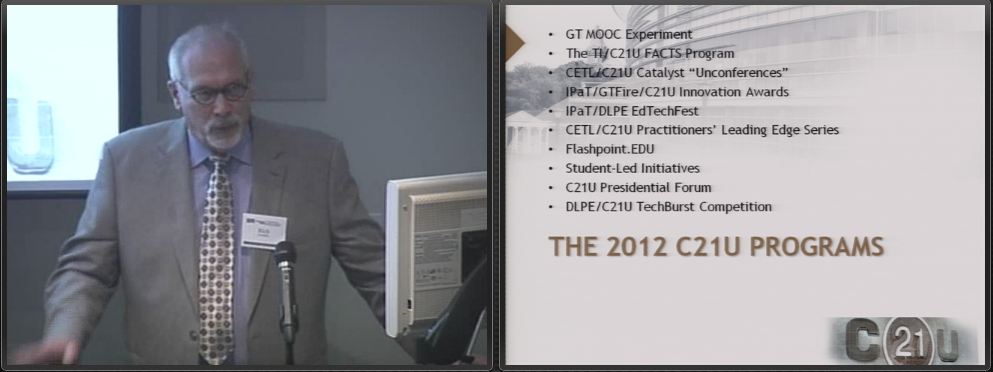
Enjoy the C21U Launch Webcast. Join Jonathan Cole, Alan Kay, Roger Schank, Director Rich DeMillo, Jeff Selingo, Tech President Bud Peterson, and others as the Center for 21st Century Universities announces its inaugural programs.
#change11

Enjoy the C21U Launch Webcast. Join Jonathan Cole, Alan Kay, Roger Schank, Director Rich DeMillo, Jeff Selingo, Tech President Bud Peterson, and others as the Center for 21st Century Universities announces its inaugural programs.
#change11

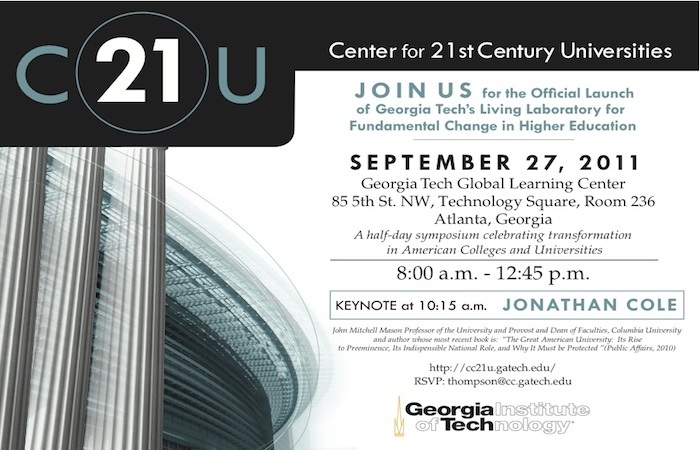
C21U Director Rich DeMillo invites you to join Georgia Tech President Bud Peterson, Vice President for Research Steve Cross, Dean Zvi Galil, Jonathan Cole (former Columbia University provost and author of The Great American University), and a panel of educational innovators for the launch of The Center for 21st Century Universities (C21U). Learn how you can participate in C21U, Georgia Tech’s living laboratory for fundamental change in higher education.
This event is a chance for anyone with an interest in higher education to hear a steller cast of leaders from industry and academia share their ideas about the future of higher education and the disruptions in store for American universities.
Events kick off in the atrium of Tech’s new Wayne G. Clough Building at 5p.m. on Monday September 26 with a networking mixer that features posters presenting projects in innovative educational technology and a student led panel discussing the future of higher education from the student perspective. This is a drop-in event, so please feel free to come by, chat with Jonathan Cole, and see what C21U is all about.
8:00-9:00 a.m. Continental breakfast
9-9:15 a.m. Welcome and Opening Remarks
9:15-10:00 a.m. Keynote Address: Jonathan Cole
10:00-10:30 a.m. Announcement of C21U programs for 2012
10:45a.m. -12:30 p.m. All-Star Panel Discussion, Q&A,
Moderator: Jeffrey J. Selingo, Editor, The Chronicle of Higher Education
Panel:
12:30-12:50 p.m. Announcement of 2012 Presidential Forum and Closing Remarks by President Peterson and Rich DeMillo
RSVP to Mary Clair Thompson to reserve your seat
#change11
Last year, I posted a cautionary article about the danger of letting opponents define you. If you thought I was overwrought when I suggested that “Picking Daisies” — the campaign ad that in all likelihood sunk Barry Goldwater’s presidential ambitions–had anything to do with public support for higher education, let me encourage you to spend the next hour watching this little number. It is called “College Conspiracy,” and it has one message: “College education is the biggest scam in US history,” I have made it easy for you. Just click play.
If you doubt that political warfare is being waged and that its aim is to provoke rage– to undermine public support for colleges and universities–just sit back as the ominous music leads you to the inevitable conclusion:
There is no reason that we the taxpayer should be funding college education.
It’s available on dozens of video sharing sites, including YouTube, which reports over two million views. That number is an order of magnitude larger than the number of copies of all books about how to improve higher education published in the last decade. Two million enraged viewers is enough to sway votes. It’s enough to pressure legislators. It is a large number.
There are close-ups of distraught faces and stories of foul greed:
Education ruined my life!
The camera shifts to the sympathetic interviewer:
They’re just vultures.
A clearly knowledgeable and steely-eyed commentator says that you don’t need a college degree to be successful and that the escalating costs of getting one is a harbinger of hyperinflation.
The narrator, with charts and graphs, argues that, like semiconductors, prices should actually be going down. For-profit colleges and traditional institutions are all painted with the same brush. They defraud students who, in exchange for exorbitant fees, end up with a worthless piece of paper that qualifies them for exactly the same low-paying jobs that high school graduates hold. Despite the Georgetown data showing that we have too few universities, steely-eyed commentator says that we have far too many.
You can pack a lot of disinformation into an hour. It took just thirty seconds to sink Goldwater. The problem is that “College Conspiracy” intermingles facts with distortions and tortured logic.
What nobody is told, for example, is that universities like the University of Chicago have reconstructed their approach to college football to make sure that it supports the academic mission. Or that a college education can be worth a lot to a student who studies at the right school and majors in the right subject. It doesn’t matter. Two million times, a story with elements of truth beat like a drum the message that higher education is not worthy of public support. What do we say?
Here is how I answered that question last year:
How do American universities respond? Meekly. As reported in the Chronicle of Higher Education, university leadership has been slow to recognize the direction and force of prevailing winds. A common mistake in business and politics is to focus on the feel-good stuff that is ultimately valueless, and universities are making the same mistake. The Chronicle reports that former MIT vice president John Curry told a gathering of heads of public universities to stop clinging to “worn out myths about campus strengths.” Curry told the group, “We like our stories more than the truth.” That leaves a vacuum for others to tell their versions of the truth. It was devastating to Goldwater and it will be devastating to higher education.
Facing the truth is an important part of focusing on the value of a university education, and Gerard Adams–the force behind “College Conspiracy”–knows that. He is the sympathetic interviewer. He is also president of the National Inflation Association (NIA), which produces not only “College Conspiracy” but other doomsday videos predicting hyper-inflationary consequences of monetary policy, healthcare reform, and food prices. What NIA is really all about is promoted prominently on their website:
Our goal is to help as many Americans as possible become aware of the disaster we are rapidly approaching. In our opinion, the wealth of most Americans could get wiped out during the next decade, but it will be an opportunity for a small percentage of Americans to become wealthy by investing into companies that historically have prospered in an inflationary environment, such as Gold and Silver miners and Agriculture producers.
NIA is a fringe group,and their activities are under scrutiny. But two millions viewers is a lot of viewers. Add to Gerard Adams conservative economists like Richard Vedder, who says through his organization Center for College Affordability and Productivity (CACP):
The pell-mell investment in sheepskins is beginning to look an awful lot like something our economy has seen in real estate: a debt-fueled asset bubble. It might end just as badly.
CACP has a message that is capable of reaching mainstream Americans. On the September 16, 2011 edition of the NBC Nightly News with Brian Williams, Richard Vedder’s voice was the one that reached 7 million viewers. He said college was “less good” as an investment. New York Mayor Michael Bloomberg said, “College kids can’t find jobs and that could lead to riots in the streets.” And then there was an anonymous student who said to all of Brian Williams’ 7 million viewers: “College is a scam.”
Add the NIA audience to the NBC audience and you get roughly 10 million viewers. “Picking Daisies” was watched by an audience of 50 million. The Republican response was to complain about the fairness of the ads, but a week after the ad aired, a Harris poll found that half of all Americans believed that Barry Goldwater would involve the US in a nuclear war. What will be the response of higher education to “College Conspiracy”?
Others will define you if you don’t define yourself.
#change11

Here the reasoning behind one of my criticisms of higher education: the factory model — a model that is in near-complete collapse — was imposed upon universities at the turn of the 20th Century by well-meaning industrialists who simply wanted to establish some discipline on the chaos that reigned in those days. Their charges jumped on half-developed industrial engineering theories and folded them into public policy, and that is the legacy we cope with today in the form of bloated bureaucracies, an over-reliance on measuring inputs, ineffective testing, and a largely parasitic accreditation industry.
Now we have a new generation of tinkerers who hear that costs are out of control and want to automate the hell out of college teaching instead of focusing on spending the money more wisely. Let me give you a preview of one of my conclusions: it’s not that we cannot afford to teach undergraduates the old way, it’s rather that everything from intercollegiate athletics to debt-laden performing arts centers grabs budget dollars before they get to the classroom. The main financial threat to American colleges and universities is mission creep, not a lack of robot-teachers.
That’s why I was particularly intrigued by Audrey Waters’ critique of Khan Academy that appeared in Explainer. I am a fan of Khan and especially his content — in fact, we are launching a program called TechBursts at Georgia Tech’s Center for 21st Century Universities to experiment with how to deconstruct a mature curriculum along those lines — but like Waters I am somewhat alarmed that there is such a rush to declare Khan Version 1.0 such an unqualified success.
It’s not that I am swayed by the “Yes but conducting a hands-on experiment is so much better than Sal Khan’s explanation of force…” argument. Indeed, deliberately taking the laboratory out of an introductory physics course does not seem like a good idea, but Khan does not advocate that either. Classroom inversion would in fact allow more time for mentoring in a more interactive laboratory setting.
It’s rather that I have not seen a cogent analysis of these critiques:
It’s unlikely that the first generation knowledge bursts that Salman Khan assembled on a shoestring are the salvation of higher education. They are Version 1.0 of a technology that has not even been thoroughly wrung out yet. It’s great that Bill Gates is a backer, but does anyone remember Windows 1.0? It took Microsoft three versions just to get it working.
#change11
They are consistent memes. We do not have to invest in American colleges and universities because (1) most jobs do not require a college degree, (2) there are too many college students already, or (3) long-term income is not related to level of education.
I hear their echos at neighborhood social gatherings. CCAPs Richard Vedder has been touting off-shoring and the shortage of tradesmen as a reason for not “mindlessly increasing college enrollments” for several years now. They are a consistent talking point in states that feel the need to reduce their expenditures and see the public university system as a fat, juicy target. If college graduates wind up driving cabs and flipping burgers — cartoonish versions of the truth — what is the real value of a college diploma?
Before anyone else buys into the idea that we need fewer — not more — college graduates, we should probably go to the videotape. A report entitled The Undereducated American casts grave doubt on some underlying assumptions that sound plausible on the surface but seem to crumble away when they are examined more closely.
Anthony Carnevale and Stephen Rose focused a lens on the production of college graduates compared to the market demand. They concluded that
The most striking thing about their analysis is that it relies on traditional economic theory. Employers would have to be in a national conspiracy to behave irrationally to conclude otherwise.
According to Carnevale and Rose, the demand for college graduates has been growing at 2% annually since 1980 but the higher education system has been falling short of that demand by at least 0.5%. That’s a current deficit of 20 million college trained workers.
To put that in perspective: it would take an additional 200 universities the size of Georgia Tech just to fill that gap.
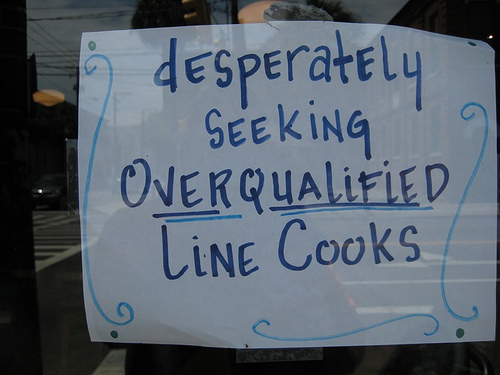
What about the idea that college graduates are being shunted into low-wage jobs that “don’t require a degree?” In truth college graduates hold only a tiny percentage of the jobs for which a college education is overkill. College-trained workers account for only 7% of the total number of cashiers and hairdressers for example. It is simply not true that the nation’s colleges and universities are producing overqualified line cooks.
Remarkably, even in those cases where a low skill job is held by a college graduate, a bachelor’s degree results in a “wage premium” for workers. On the average, college-educated hairdressers earn nearly 70% more than their high-school graduate workmates. Retail sales clerks fare even better: the 18% of the retail sales personnel who have college degrees earn 73.2% more than someone who has only a high school diploma. It is a wage premium that grows to 75% for some middle skill jobs.
Carnevale and Rose also analyze income discrepancies across the entire economy, concluding that the lack of college-trained personnel to fill available positions is a cause of income inequality. It is a problem that is compounded by the increasing selectivity of some colleges and universities. They with increasing frequency select their freshman candidates from a narrow socioeconomic pool. So, not only do they earn more, but they come from families with disproportionately large incomes and personal fortunes.
Arizona State president Michael Crow once laid a large chart in front of me and pointed out that “The United States has not increased capacity in higher education since 1960.” He was right. We need 200 more universities just to get back in the game.
 Innovate.EDU