The Joint Commission Education Subcommittee is a strategic science and technology initiative of the Georgia Senate and General Assembly that seeks to chart the tech legislative and policy direction for the state of Georgia.  A copy of the resolution can be found here.

The subcommittee met at Georgia Tech on October 18 to discuss the role of STEM education in meeting Georgia’s growth aspirations in science and technology.

I organized my recommendation to the subcommittee around three principles:

  1. The role of technology
  2. The role of teams
  3. Do not miss opportunities

Here is a transcript of my remarks:

SR28 Committee Remarks

#change11

There was a time before TSA and 9/11  when crazy people wandered freely around the nation’s airports. I was heading to the Eastern Airlines gates at O’Hare when I was stopped by  a guy in a suit wearing a sign that said there was now mathematical proof that the country was going to Hell in a hand-basket. I slowed a beat but it was enough for him to shove a magazine in my hand. “You should read this!” he said. “They don’t want you to know about it!.”  I glanced at the cover. It was Fidelio, Lyndon Larouche’s magazine of culture and science. “Great,” I thought. “NCLC propaganda.”

I was ready to bolt for the Eastern passenger lounge, when the guy tugged the magazine from my hand and flipped it open to a Larouche rant about Georg Cantor and transfinite numbers. My next mistake was to say something like, “Well, this is a load of crap.” I had taught set theory and for a brief instant I imagined that I could  waste a little time toying with the guy before pounding him to intellectual  pulp. It was the opening he was looking for.

I was hopelessly over matched. Never mind that I knew that he had no idea what he was talking about. Norbert Weiner, the Reimann Hypothesis, Plato, and  negative entropy and were all smashed together, mixed and reshaped as a serious critique of western political economy. He was getting louder and more aggressive, so I grabbed my bags and headed down the concourse at full speed with this guy and his sign chasing after me yelling in a vaguely threatening way.

I can’t stay away from encounters like that. I have had other run-ins with zealots who are shameless about misquoting, misapplying, and misappropriating stuff that I happen to know something about. I want to unmask them in public. Show them for the frauds they are. I tell you this story to prepare you for my comments about the worst abuse of a deep and very important idea that I’ve seen in a long time. It may end badly, but I can’t stay away.

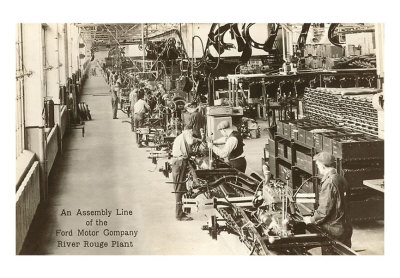
My attention was drawn to a recent  CCAP post about unnecessary cost escalation in higher ed by Andrew Gillen who is inspired by Charles Babbage to suggest that there be a “division of labor” in which the job of lecturing is separated from the job of grading.  The result according to Mr. Gillen would be a 30% reduction in costs that can be passed along to students in the form of tuition reductions.

I am a computer scientist, so Charles Babbage is intellectually speaking a friend of mine, the originator of the very concept of a computer.  Nobody knew how to mechanize better than Charles Babbage. His book, On the Economy of Machinery and Manufactures, is aimed at the upwardly mobile assembly line workers of 19th century England. It is an explanation of manufacturing economics for the common man.

In 1850 London’s mills and factories were houses of horror:

Any man who has stood at twelve o’clock at the single narrow door-way, which serves as the place of exit for the hands employed in the great cotton-mills, must acknowledge, that an uglier set of men and women, of boys and girls, taking them in the mass, it would be impossible to congregate in a smaller compass.[P. Gaskell, The Manufacturing Population of England. London, 1833, pp.161-162]

I won’t recount all of Babbage’s arguments beyond saying that the mechanization of, say, the production of sewing needles–in which the dangerous and expensive alignment of parcels of metal so that the ends can be sharpened before they are separated can be done more cheaply by a primitive robot–has virtually nothing to do with the craft of being a university professor.  Yet here is what Mr. Gillen takes away from the Babbage text:

In higher ed, we need high [sic] skilled people for some aspects of the job (designing courses, creating assessments, mentoring, etc.) but many of the other tasks they perform don’t require as much skill, and could be performed much more cheaply by lower paid workers (routine grading, administrative tasks, most office hour questions, finding and dealing with cheating, even some of the teaching). And yet all tasks are performed by the most highly paid people.

Mr. Gillen is right that de-skilling is important in controlling costs.  It is a problem to be solved in healthcare, government and education, but not in the way that Mr. Gillen suggests. I’ve seen this argument enough in the last few weeks to know that there might be trouble brewing, so let me restate some points that are well-known to readers of Innovate.EDU:

  1. There is simply not that much expense tied up in grading exams. It may be a pain in the ass for professors to plough through mountains of blue books, but the productivity gains of separating lecturing and grading are negligible.  How do we know that?  The experiment is being conducted every day in departments that make heavy use of teaching assistants as graders.  If there were great productivity improvements to be had, they would have been noticed already.  They have not.
  2. Mr. Gillen’s  separation of labor concept actually makes matters worse for learning. An example of how it might be done is Salman Khan’s brilliant idea of inverting lectures and homework. Unlike Gillen’s proposal, this invests more professor time in one-one interaction with students, not less.
  3. Universities are not factories. Most of the problems facing higher education today can be traced to this false analogy.
  4. There is no conceivable educational benefit of decoupling the feedback that a professor gets from personal interactions with students.  Even if you are committed to a time-honored systems of lectures and exams,  simple questions like whether  the material is getting through cannot be answered by shipping students off to a specialized team of graders and routine question-anwerers.

In fact, Gillen has it exactly backwards.  The De-Skilling Argument is this:  let’s take the least value-laden part of teaching out of the hands of high-priced professors. The most valuable part of teaching lies in the personal interaction of students and mentors and in the peer-to-peer interactions of learning communities.  Why would anyone want to depersonalize that?

The issues raised by this notion are both legion and obvious.  How would you know in advance which office hour questions were routine? Why should delegating routine administrative tasks — whatever those might be — to unskilled labor lead to savings anyway? Don’t learning management systems/course management systems purport to do the same thing already? Why would this proposal not lead to increased costs as new, unskilled workers are added to the university workforce?

It’s not a fair fight, but the CCAP proposals are sometimes the only ones out there — and they are listened to — so someone needs to shout “Well this is a load of crap!”

Now, where’s that Eastern Airlines lounge?

In a few days I will publish a short comment on the difference between Big Fixes in higher education and Small Fixes. Big fixes are things like policy changes at the federal and state level. When Big Fixes go wrong, there is no way to predict how systems will fail.  No Child Left Behind was a Big Fix, and the damages are still unfolding.

Technology innovations are Small Fixes. I’m not talking about new technology that force-fits a 16th century educational system into a hyper-techno contraption.  I’m talking about innovative things that are not obvious and may not even have an obvious application to education. Most iPad apps are Small Fixes for some bigger problem. Small Fixes are important precisely because you can assemble a lot of them and stand back while some invisible hand fishes out the ones that actually add value. Blogging is a Small Fix for higher education.

I was preparing for a class on nanotechnology a few years ago, and I needed an example to illustrate how much heat would be generated by a wide scale deployment of cell-sized nano-computers.  I wanted the class to calculate the energy dissipation of a film of these little computers on all paved roads in the US. But how many miles of paved roads are there?

I looked through atlases, online maps and more websites for departments of transportation than I care to remember.  In the end I took a stab at it:  2 million miles more or less. It was a case of misplaced priorities.  No one but me really cared what the right number was (or even if there was a right number).  I was anticipating that some wiseguy graduate student would want to know where the number came from.  That never happened.  It was a waste of time.

I was reminded at some point in this literal journey through the back roads of America that my old friend and colleague Alan Perlis had the knack of pulling computational examples like this out of thin air. “How many bricks are there in New York City?” he would ask during an oral exam, and then he would sit back and watch the gears turn. Well-oiled gears would tune in quickly to an interesting line of reasoning.  That was the point.  Not-so-well-oiled gears would cause of a lot of embarrassed thrashing.

I vaguely remember wondering, “What would be the value of being able to create and re-create many examples with a sort of search engine for computational knowledge?” I thought nothing more about it until I stumbled upon WolframAlpha, a “computational knowledge engine” from the company that distributes Mathematica. WolframAlpha is a website, and the first thing you should do when you land there is to type in a question.  So I asked how many miles of paved roads there are in the U.S. You can see the result above. In addition to the answer itself, you get a plausible chain of reasoning that leads you to that answer.

Here is what Stephen Wolfram says about WolframAlpha:

Realistically, though, we haven’t been “discovered” yet in even a small fraction of the areas we cover. We don’t know the whole process by which that happens (and it would make a fascinating study), but somehow, gradually, different areas of Wolfram|Alpha functionality do seem to be “discovered”, and progressively build up larger and larger followings.

This is really the essence of a Small Fix.  Wolfram points out that an engine like this has been the dream of philosophers for centuries.  An “assistant” who assembles knowledge in context. Leibniz’s idea was to accelerate the pace of inquiry. As one of the comments on Wolfram’s blog says:

Every once in a while I can’t help but think that Liebniz must be having a party in his grave!

What impact might WolframAlpha have on education?  Maybe none, but there’s almost no cost to finding out. I can’t help but think that Leibniz would have found a way to say, “Cool!”

The first thing you notice is the chaos.  There is no one in charge. No place to go to find out what to do. There was a time when Apple stores did not have blue-t-shirt greeters at the front door.  You just had to stand there, trying to make sense of the clusters of customers, gawkers, helpers, facilitators, and salesmen.  Everyone  seemed to be either milling around or hustling off someplace with a sense of purpose, while you just stood there wondering what to do next. My first experience with a MOOC (Massive Open Online Course) was like that.

I was writing the chapter on open learning in Abelard to Apple when I noticed that a group of Canadian learning technologists and innovators, led by George Siemens, Stephen Downes and David Cormier were organizing a course that was open to the world.  Here is how I described it in Abelard to Apple:

Open-ended college courses are uncommon, but not for any pedagogical reason. There is no theory that dictates how college degree programs should be chopped into courses or how many semesters there should be, except that everything should work out to be just long enough to fit the required number of credits. Many institutions offer “Maymester” terms that fit between spring and summer and last two or three weeks. Advanced material is sometimes taught in small recitation groups and is spread over several semesters because there are as of yet no textbooks in the field and therefore no natural course boundaries. The length of a college course is a number that is chosen arbitrarily, and it varies from place to place.

Attendance is also a loosely defined idea for most college courses. In Europe, where completion of course requirements is determined by final examinations, attendance has no meaning at all, and students feel free to drop in when it suits them. Even in American classrooms, instructors rarely take attendance, and the only evidence that regular attendance affects learning is purely anecdotal.

There is no scientific reason that universities have not organized their curricula around Erdös-style open-ended courses. In 2008, George Siemens, a professor at Athabasca University—the Canadian version of Britain’s Open University—and a research scientist for the Canadian National Research Council named Stephen Downes decided to offer a course on a theory of learning that they call Connectivism and Connective Knowledge, or CCK. CCK is a long tail concept, a pedagogical theory asserting that learning takes place as students discover how to navigate the interconnected networks across which knowledge is distributed. Their course was about CCK and simultaneously used CCK as the primary teaching method. It was offered again in 2009, and eventually attracted several thousand students.

I not only wandered into a MOOC, but I also was handed a blue t-shirt, one of those black id tags on a lanyard, and a mobile phone so that I can connect new arrivals to people who can actually help them. This happened last year when George sent me an email asking whether I was interested in participating in a new MOOC that he was organizing.  This one was about change in higher education. He wanted to call it, appropriately enough, “Change, Education, Learning, and Technology.”  I said, “Sure!”.

Here’s where the Change MOOC lives.  Actually, it lives lots of places.  You can find it here as well. And if you are a member of the Georgia Tech community you can also find it here. There are Twitter feeds that you can find with the hash tag #change11. There is even a virtual study group at OpenStudy.com.  Change11 is just entering its 5th week, and there is already more content than I can track.  I find myself paging though FlipBook late at night just to see what’s up.

Who’s taking the course?  It’s really impossible to say because many of the thousands who have registered already never say who they are or participate in the online discussions.  But many hundreds do. They are mainly teachers, and they come from elementary and secondary schools around the world.  There are also a fair number of educational consultants, bloggers, and professors who do research in education and educational technology.  Conversational clusters self-organize. There are fights that crop up among groups that hold differing positions on important issues, and there are a few water balloons that are lobbed between groups.  There are trouble makers, and serious students, casual observers and opinion-makers.

Who’s missing? People who should be getting comfortable with the disruptive forces in higher education. There are almost no university administrators or technology managers.   EDUCAUSE is nowhere to be seen.  There are dozens of websites that devoted to studying and commenting on policy issues, but if they are aware of Change11, they are silent about it.

Is Change11 or MOOC-fication the wave of the future? Probably not.  It’s an experiment.  It is no more likely to be predictive of what the future of higher education will be like than Stanford’s open course on Artificial Intelligence. Like all experiments, success is not the important factor. One thing is certain: higher ed desperately needs innovation and the only way to innovate is to try out a lot of ideas.

I was attracted to the MOOC concept because it illustrated a narrative that I was constructing for my book, but I was drawn into the idea of the course by the Greeters who assured me that the whole point of being there was to navigate  concepts and discussions that were meaningful to me.

So now I find myself greeting new arrivals with: “Hi, I’m Rich. Can I help you find what you need?”

If you are lost already — if you feel like you have jumped into the middle of a conversation — then let me suggest that you click on the video above.

http://www.youtube.com/watch?v=vMx4xj95B6I

TechBurst Competition 2011

Share what you know…

TechBurst

: ( noun ‘tek’berst ) a short, sharable video that explains a single topic or concept in a particularly entertaining and compelling way. The best TechBursts are viewed thousands of times.

TechBurst Competition 2011

:help to populate the TechBurst library and to recognize the most creative Yellow Jacket mentors. If you worked hard to understand a difficult concept and have a novel way of explaining it to your classmates, share what you know in the 2011 TechBurst Competition. Participants will produce their own videos and leave them behind for future Yellow Jackets. The best videos will be viral Internet hits. Winners will receive $5,000 in cash prizes and gifts.

The Rules of TechBursts

:there are only four rules of TechBursts

  1. They are short (no more than 10 minutes)
  2. They are creative (nobody will watch boring TechBursts)
  3. They are self-contained (your classmates will put them together in unpredictable ways)
  4. They are meant to be shared (you are leaving a legacy to make life a little better for those who follow

Where to Find Examples of TechBursts

:there are no TechBursts today. Soon there will be hundreds of them, and yours will be the examples that other students use. For examples of bursts that people in other parts of the world are creating, try visiting Kahn Academy (http://khanacademy.org) or The RSA (http://comment.rsablogs.org.uk/videos/).

How to Create TechBursts

:you will probably invent your own approach to creating TechBursts. Technology is important, but you can get started with simple tools that are freely available on the web (see http://www.labnol.org/internet/khan-academy-style-videos/19875/).

Eligibility

:current Georgia Tech undergraduate or graduate students can enter individually or in teams. A student can be a part of as many individual or team submissions as he or she wants.

Expressing Interest, Intent to Compete & Registration

:individual students and student teams must complete one TechBurst Topic Registration Form per submission. These forms can be completed between October 1 and October 30, 2011.

Register here

How the Competition Works

:semi-finalists will be selected on the basis of creativity and clarity. Semifinalists will submit rough videos to a panel of judges who will select a group of finalists. Finalist videos will be uploaded to a TechBurst YouTube channel for the world to see. Winning videos will be determined by combining crowd sourced reviews and ratings with the reviews of an expert panel. Winners will be announced at the 2012 C21U Presidential Forum.

Production Assistance

:individuals and teams are free to use any technology at their disposal to produce their TechBurst video. In fact, the more creative, the better. Finalists will have access to the Georgia Tech’s Distance Learning and Professional Education studios and facilities. If you think you will need access to production assistance please indicate on the registration form. The Georgia Tech Library also has facilities that are open to all students that may be helpful.

Prizes:

  • $2,500 – First Place
  • $1,000 – Second Place
  • $500   – Third Place
  • $1,000 – People’s Choice Award for Innovation
  • * prizes divided up equally to members of ad hoc teams

#change11