Critics seem hell-bent to fabricate exotic reasons that college tuition is rising. “It is a market response to free-flowing federal dollars”, say some.  “It is a conspiracy,” say others. “Declining productivity!” say those who are convinced that college professors are overpaid and underworked.

The 2011 annual spending report of the Delta Project on Postsecondary Education Costs, Productivity, and Accountability — the last annual report issued by Delta before it sadly closed its doors last spring — makes it clear that easy answers are likely to be wrong:

There is much public discussion and concern over rising tuition but much less attention to the intricate relationships among tuition and revenue sources–particularly state and local appropriations in the public sector — and spending.

Take the issue of lost appropriations, for example. It is true that from 1999 to 2009 tuition at public research universities rose at a much higher rate (56%) than the 32% increase at their private counterparts.  These increases are almost entirely explained by the loss of state appropriates, as opposed, say, to increased spending.

All other factors are incidental. Nor does the rate of increase tell the whole story, because private universities are starting from a much higher base for their sticker prices the average dollar increase at the private institutions was three times that of the private universities.  The situation is much worse at public community colleges which have seen the greatest increase in enrollment. This is because, when it comes to tuition, even small changes in enrollment headcount have a big effect on prices. And that is where capacity comes into play.

Private universities have been able to keep their increases in check because they do not accept as many students as they could otherwise afford.  The increasing enrollment pressures have been absorbed by community colleges, and public masters and research universities. Students, who cannot afford to attend private institutions flock to quality public universities.  These are the very institutions that have not added capacity over the last forty years.

It is seductive but entirely false to think of higher education as a single sided market — that is, a system in which there is a supplier of goods and services to a customer who is willing to pay a price determined by the marginal cost of production.  That is not higher education.  Higher education is a multi-sided market, a collection of stakeholders with often competing interests and cross subsidies that make it difficult to determine fair pricing schemes.

Local newspapers were a multi- sided market,  in which extremely profitable classified advertising subsidized news, subscriber fees, and print advertising.  It was a system that worked well until Craig’s List came along an undermined the whole value proposition that supported local news.  The result was rapidly dropping classified ad revenue, rapidly increasing print ad rates followed by a corresponding drop in demand for print ad, and ultimately a cash crisis in which subscribers fled to other media for their local news.  Newspapers were slow to recognize that they were a three-sided market. 

Higher education is taking the same path, and that is significant because it helps explain why the lack of capacity in American universities lies at the root of cost increases.

Success in a multi-sided market is determined by platform success in which a single horizontal layer allows many stakeholders to share common services at a total cost that is less than the cost of offering those same services in a vertically integrated business.

A multi-sided business without a scalable platform eventually succumbs to the nonlinear costs of growth.  Not only do the various services have to work out pairwise agreements with the other services, but individual stakeholders must also do the same.  As the number of stakeholders grow the overall cost of providing services grows in proportion to the ad hoc arrangements needed to keep everyone happy.

Universities have not invested in platform scalability for at least the last fifty years. Their processes and structures are locked into a set of capacity assumptions that are falling by the wayside. And they are rewarded for growing in a market where students seeking value are fleeing lesser institutions for those that are already overcrowded.

The obvious losers are the second and third tier institutions who desperately need students.  These are the schools that offer the steepest discounts. So steep that they cannot sustain them without falling into the financial danger zone I have talked about before.

The other losers are the students who are driven to higher quality by increasing prices.  Which institutions are they?  They are the very universities which have not added capacity but which have incentives to continue growing.

It is growth that comes at nonlinear costs.  There are no easy ways for most institutions to subsidize or cross-subsidize those costs, so they are passed on to students.

Next:  Where does the money go?
What is Driving Up the Cost of College?“, asked the question that many outside and inside academia want to know the answer to — especially this time of year as families contemplate writing college tuition checks that over four years will top $200,000   According to a recent Pew poll, the majority of Americans believe that a college education is becoming unaffordable and want to know why. Facile explanations are easy to come by, but there are few that match the facts.

So what’s going on?  Much of the popular discussion of tuition increases is based on three  “facts” that  are not true.  They may be easy to toss off on editorial pages or cable talk shows, but they are myths.

Myth 1: The rate of college tuition increases is abnormally high.

If you listen to many commentators, college tuition is hyper-inflationary.  In fact, students at many public campuses have seen tuition and fees double over the last decade, and–as the stubbornly persistent effects of the recession strain family budgets–become increasingly unaffordable.

Affordability is a real problem and prices are on an unsustainable path, but it is not the case that we are in the middle of some hyper-inflationary bubble.

In normal times, tuition rises at roughly twice the rate of inflation.  From 1958-1996 that averaged somewhere near 8%.  For most of those years, the increases were offset by increased spending for financial aid and by general growth in personal income, which hid many of the most serious consequences of this rise in prices.

Recent years are different, some argue. Let’s take a look at that claim. Annual inflation for 2011 was 3.16%, but that actually understates inflation for the months in which trustees and legislative committees approve tuition increases. The  annual rate of inflation for the last three quarters of 2011 was just under 3.5%.

Private institutions  raised their prices last year, but the rate of increase was actually in line with inflation.   2011-2012 tuition increases at nonprofit private institutions averaged around 4%.  For-profits increased their prices  3.6%. When it comes to holding the line on prices, these institutions actually performed much better than historical trends.

Public universities raised their prices at the much more dramatic rate of 8.6%, 20% above historical highs of the decade 1992-2001.

In short, the only increases that are above historical highs are at public universities, but only by a relatively modest amount.

Myth 2:  Easy availability of Federally-backed student loans is driving tuition increases.

This is a myth with many political consequences, but there is very little evidence that it is true.

The theory behind this myth is that a free market will cause prices to rise in proportion to a market’s ability to pay those prices, and the widespread availability of federal loans affects a student’s ability to pay.  The often unstated political corollary to this theory is that the students who are least able to pay are also the ones who are least likely to complete their degrees and pay back the loans.

In reality, the part of the higher education market that has control over its prices has been demonstrably immune from any such affect.

Less than 40% of all Federal aid is in the form of student loans (the rest is used for Pell grants and merit-based support).  These loans are distributed to public, non-profit and for-profit institutions, but for-profits tend to get a disproportionately large percentage of these loans.   These are the institutions that have raised their fees the least.

The remaining loans are distributed to nonprofit and public institutions, but since non-profits have also had historically low tuition increases, all of the factors affecting tuition would have to be concentrated in the sector that has the least flexibility in setting its own prices — the public colleges and universities. And as we have seen prices when viewed as a multiple of consumer price increases have risen only 20% faster than historical averages at these institutions.

Public institutions cannot retain earnings, so costs would have to have risen in proportion to loan availability, but that has not been the case.  Costs at public universities have been constant for several years.

So why have prices increased? In fact, total state support for public institutions dropped 7.5% in 2011-12. The total increase in tuition can be attributed to making up for lost income. Federal loan availability may be correlated with tuition increases but there is no reason for believing it is a cause.

Myth 3: Tuition rises because of declining productivity.  Professors are earning more and teaching less.

Productivity is not easy to measure in academia, but one thing is certain: unproductive professors are not a contributing factor to rising tuition.

One popular measure is the average ratio of students to faculty in general education courses.  This number has risen significantly at public universities whose state budgets have been squeezed.  In many industries this would be the very definition of increased productivity, which would mean that rich professors are skimming the cream off the top of rising revenues.

That is not true.  Faculty salaries have been stagnant at public colleges for almost a decade.  Many large state institutions have resorted to hiring part-time or “contingent” faculty to satisfy increased demand, which further depresses average annual compensation.

Another  measure of productivity is the number of courses taught per semester.  This number has been on a slight decline for over a decade, which might indicate that prices are going up even as productivity is decreasing.

However, the decline in average teaching load has been most noticeable at schools that are building sponsored research programs.  As I have pointed out in prior posts, sponsored research seldom pays for itself, so a decline in teaching loads represents, not  a productivity decrease, but rather a shifting of costs from academic programs to another income producing activity but one which often fails to cover even its own costs.

Next:  Three Reasons that Tuition is Rising: Capacity, Capacity Capacity

Sometime last year — exactly when depends on whose data you rely upon — the debt total of American college students topped a trillion dollars, surpassing credit cards, second only to home mortgages as the major source of indebtedness for students and families.

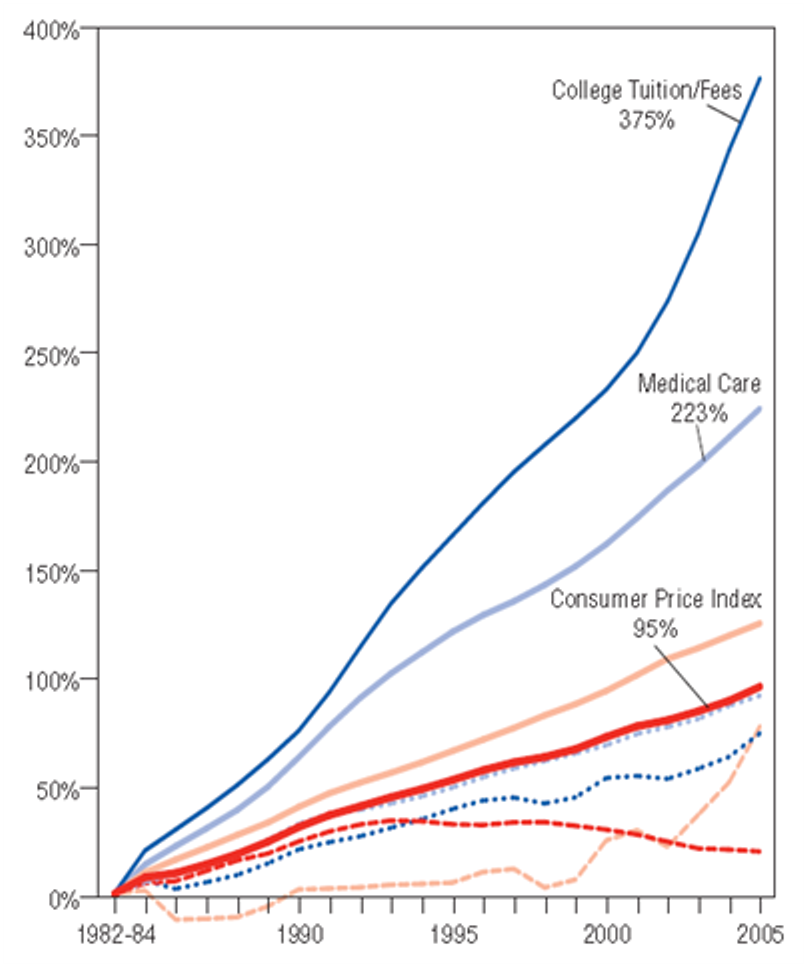
The principle reason that students are taking on debt is a dramatic rise in the cost of attending college. I have used this chart on other occasions,  but it is still the most dramatic illustration of what has  happened to  college tuition over the last twenty years.

This chart stops at 2005.  From 2005 to 2012, tuition has risen at an annualized rate of 8%. It is a breathtaking climb, and it means that students (and their families) are turning to student loans in unsustainable numbers.

None of this is news.  It is fodder for cable TV talk shows, Presidential campaign speeches, and a considerable number of faux populist attacks on the very idea of a college degree. The Obama administration has even weighed in with a Race to the Top for Colleges initiative that focuses to a large measure on affordability.

Conservatives say that it is the ready availability Federally backed loans that a driving cost increases.  Progressives –including many who support the Occupy Wall Street movement — say that that a the same cultural factors that drove banking abuses are also driving the disparity between who can afford a college education and who can not.

There is little evidence that either statement is true and considerable evidence that neither are. I will return to this subject in a later post.

The first thing to understand about the rise in college costs is the difference between the cost of running a university — the spending side of the equation —  and the price paid by students. In higher education there are all kinds of prices.  There is the advertised or sticker price, which is what it sounds like. But sticker prices can be discounted, and there are also wholesale and retail prices.

For-profits aside, you would think that there would be a straightforward relationship between costs and prices since, after all, the name of the budget game in a university is to take in just enough revenue to offset the costs of operating programs and facilities.You would think, for example, that costs were simply passed along to students in the form of tuition and fees, which are components of the revenue side.

If that were true then rising tuition would be a result of rising costs.  Some costs, like healthcare, have risen dramatically, but the rise in tuition is for the most part unrelated to increased operational costs.

College costs are high and have been high for at least a hundred years. When Harvard President Charles Elliot began  to dismantle the university’s rigid core curriculum — replacing it with an elective system — in the late 19th century, he grew the size of Harvard’s faculty tenfold. It was a shock to Harvard’s carefully tuned financial model, but it led to even more dramatic growth in private giving, creating a sustainable system in which endowed funds are used to offset variable costs of operation.

Labor alone accounts for much of the variable cost of running a university.  That means, as James Surowiecki, pointed out in his recent New Yorker article:

In other words, teachers today aren’t any more productive than they were in 1980. The problem is that colleges can’t pay 1980 salaries, and the only way they can pay 2011 salaries is by raising prices

That, however, does not really explain why tuition has risen so dramatically. Faculty salaries have been stagnant for almost a decade. Furthermore, when measured as cost per degree awarded, universities are actually just as productive today as they were in 2005.

As Surowieki points out the “arms race” that causes universities to invest in bling could explain some of the increase, except that the rate of increase in those expenditures have been flat,  too. In fact spending in general has been flat.

So what’s going on?  Have universities been pocketing the difference between what it takes to run an academic program and what students are willing to pay? The only players in the higher ed game that have the ability to do that are the For-Profits and their 3.2%  tuition increases have been the lowest among all types of institutions.

This post begins a series that over the next couple of weeks tries to answer the “What’s going on?” question.  Part primer and part road map, the series continues next week with some of the facts you think you know about college tuition that are in reality not true.

Next: Three Myths about Rising College Costs

I wrote about my first reaction to Taylor Walsh’s book “Unlocking the Gates: How and why leading universities are opening up access to their courses” way back in early January:

It’s a deep and compelling companion to Abelard to Apple, and it’s one that I plan to assign as required reading to Georgia Tech’s newly chartered Educational Technology Council.

Today the Pope Center published my full review of Unlocking the Gates. The comparisons to the birth of the web are too obvious to ignore.  My message is directed to universities who want to join the open courseware movement:  what you are grappling with today is all too familiar to those of us who lived through the media revolution  of 1995:

You do not get the feeling from most of the main characters in Walsh’s drama—many of whom lead institutions whose prices continue to spiral out control as their value is systematically hollowed out by the very technologies they once championed—that they lived through any of the events of 1995. They clearly know that a 21st century revolution is under way, but they think that their institutions are at the center of it. In reality, they are bystanders.

I am not above false equivalencies. I know that the “liberal” in “liberal arts” has nothing to do political liberals as in “Don’t vote for that tax-and-spend liberal”. But it is ironic  that virtually all of the negative comments that  Jeff Selingo’s article about giving engineers a chance to innovate in higher education came from my colleagues in the liberal arts and humanities.  That’s also been my experience with Abelard to Apple reviews and comments on this blog. The general form of the rebuke is

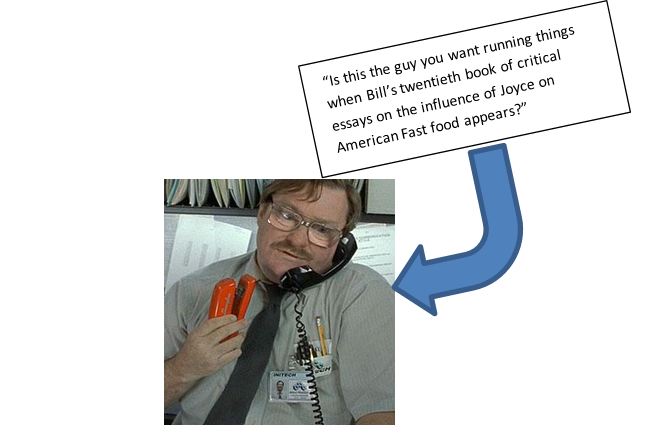
Ewww! We don’t want engineers running things.  Engineers are [insert your favorite stereotypical character flaw here]

I imagine that conjured images of pocket-protected geeks, possibly wearing glasses that have been recently repaired with white adhesive tape, making decisions in isolation of every true human emotion are supposed to rise from the printed page:

Engineers indeed have experience and skills solving problems, engineering problems, that is. These are the identical, limited skills that can make them exceptionally poor organizational leaders.  “Turn the crank and out will pop the solution” is good engineering but is not leadership.

Academics are deadly serious about this sort of stuff, and it infects decision-making at all levels of a university. It is a meme that pushes search committees away from candidates with technical credentials, for example.  The conversation that takes place out of earshot ends something like this:

I have to admit that this strategy is efficient .  It lets you separate the good ideas from the bad ideas before even hearing them. What about the pesky counter-examples? “Never mind the success of Silicon Valley.  Engineering leaders and their innovations probably played no role at all.”

There are some on my side of the fence who have a similar reaction to the humanities. I was in a Silicon Valley meeting a few weeks ago when an engineer went nearly apoplectic over the idea that the liberal arts would claim any academic legitimacy: “What do they do that’s useful?” he demanded to know.  “They’re trained circus performers!”

But this kind of reaction is relatively rare — perhaps because so many of us had liberal arts backgrounds before we became engineers. I wish the reverse were true for the humanities and the liberal arts, where it is frequently a badge of honor to proclaim ignorance of technical matters.

Back to my false equivalency. It is not worthy of the  “liberal” in “liberal arts” to pick this kind of fight. It is certainly not worthy of John Kennedy’s famous definition of a “liberal”

Someone who looks ahead and not behind, someone who welcomes new ideas without rigid reactions,

On the other hand, false equivalencies abound on the the other side, too.  Here’s my favorite: “The value of the liberal arts is self-evident and, since we are the only ones who know how to teach this stuff, so is the value of our liberal arts curricula self-evident.”  If you think I’m kidding, you might want to watch Stanley Fish defend exactly that position in the video above.

I can understand a certain amount of  defensive wagon-circling when the conversation veers toward value. Especially when a first-rate liberal arts education costs $200,000. I don’t think it’s a smart fight for the humanities faculty to pick.