Archive

Comment and Review

Time for the 2013 Edition of ACTA’s What Will They Learn?™ report.

In last year’s edition, ACTA followed the curricula at over 1,000 undergraduate institutions to see whether there was any correlation between desired learning outcomes in liberal arts programs and topics actually covered in the classroom.

Last year’s results were shocking enough.

Most high-tuition institutions — including the Ivies — failed to provide even the most basic coverage of topics promised in published course descriptions.  You would think, for example, that a humanities curriculum that promises courses in the sciences and mathematics would design courses in which students could actually learn both science and math. No so, for a shocking percentage of the institutions who ask students to pony up $40,000 per year for the experience of bypassing pretty much every useful mention of physics, chemistry, biology, algebra, and computer science.

This year’s survey results were no more encouraging: From the report’s Executive Summary:

What Will They Learn?™ evaluates every four-year public university with a stated liberal arts mission as well as hundreds of private colleges and universities selected on the basis of size, mission, and regional representation. All schools in the What Will Will They Learn™ study are regionally-accredited, non-profit institutions. Combined, the 1,070 institutions in the What Will They Learn?™ study enroll over seven million students, more than two-thirds of all students enrolled in four-year liberal arts schools nationwide.

Overall, the results are troubling. The grade tally tells the story:

A 21 (2.0%)

B 393 (36.7%)

C 338 (31.6%)

D 229 (21.4%)

F 89 (8.3 %)

Less than half of the schools studied require:

Literature – 37.9%

Foreign Language – 13.7%

U.S. Government or History – 18.3 %

Economics – 3.4 %

The Seinfeld Show

Most discouraging to me is the F grade that Amherst earned this year by requiring literally nothing. Sacrificing at the altar of curriculum flexibility, Amherst has no core requirements. This leads to an extremely high completion rate with no guarantee that a  student knows anything at all about math, reading, history, or composition.  It doesn’t have to be that way; you can dispense with a core curriculum and not sink into the academic version Jerry Seinfeld’s “show about nothing.” [See, for example, my chapter on the Threads curriculum in Abelard to Apple].
I wrote about my first reaction to Taylor Walsh’s book “Unlocking the Gates: How and why leading universities are opening up access to their courses” way back in early January:

It’s a deep and compelling companion to Abelard to Apple, and it’s one that I plan to assign as required reading to Georgia Tech’s newly chartered Educational Technology Council.

Today the Pope Center published my full review of Unlocking the Gates. The comparisons to the birth of the web are too obvious to ignore.  My message is directed to universities who want to join the open courseware movement:  what you are grappling with today is all too familiar to those of us who lived through the media revolution  of 1995:

You do not get the feeling from most of the main characters in Walsh’s drama—many of whom lead institutions whose prices continue to spiral out control as their value is systematically hollowed out by the very technologies they once championed—that they lived through any of the events of 1995. They clearly know that a 21st century revolution is under way, but they think that their institutions are at the center of it. In reality, they are bystanders.

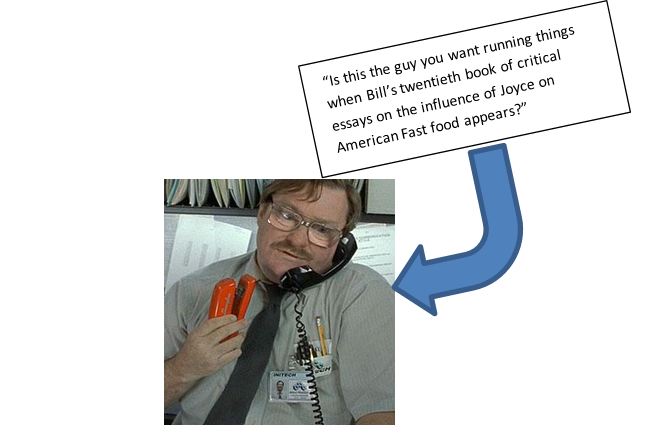
I am not above false equivalencies. I know that the “liberal” in “liberal arts” has nothing to do political liberals as in “Don’t vote for that tax-and-spend liberal”. But it is ironic  that virtually all of the negative comments that  Jeff Selingo’s article about giving engineers a chance to innovate in higher education came from my colleagues in the liberal arts and humanities.  That’s also been my experience with Abelard to Apple reviews and comments on this blog. The general form of the rebuke is

Ewww! We don’t want engineers running things.  Engineers are [insert your favorite stereotypical character flaw here]

I imagine that conjured images of pocket-protected geeks, possibly wearing glasses that have been recently repaired with white adhesive tape, making decisions in isolation of every true human emotion are supposed to rise from the printed page:

Engineers indeed have experience and skills solving problems, engineering problems, that is. These are the identical, limited skills that can make them exceptionally poor organizational leaders.  “Turn the crank and out will pop the solution” is good engineering but is not leadership.

Academics are deadly serious about this sort of stuff, and it infects decision-making at all levels of a university. It is a meme that pushes search committees away from candidates with technical credentials, for example.  The conversation that takes place out of earshot ends something like this:

I have to admit that this strategy is efficient .  It lets you separate the good ideas from the bad ideas before even hearing them. What about the pesky counter-examples? “Never mind the success of Silicon Valley.  Engineering leaders and their innovations probably played no role at all.”

There are some on my side of the fence who have a similar reaction to the humanities. I was in a Silicon Valley meeting a few weeks ago when an engineer went nearly apoplectic over the idea that the liberal arts would claim any academic legitimacy: “What do they do that’s useful?” he demanded to know.  “They’re trained circus performers!”

But this kind of reaction is relatively rare — perhaps because so many of us had liberal arts backgrounds before we became engineers. I wish the reverse were true for the humanities and the liberal arts, where it is frequently a badge of honor to proclaim ignorance of technical matters.

Back to my false equivalency. It is not worthy of the  “liberal” in “liberal arts” to pick this kind of fight. It is certainly not worthy of John Kennedy’s famous definition of a “liberal”

Someone who looks ahead and not behind, someone who welcomes new ideas without rigid reactions,

On the other hand, false equivalencies abound on the the other side, too.  Here’s my favorite: “The value of the liberal arts is self-evident and, since we are the only ones who know how to teach this stuff, so is the value of our liberal arts curricula self-evident.”  If you think I’m kidding, you might want to watch Stanley Fish defend exactly that position in the video above.

I can understand a certain amount of  defensive wagon-circling when the conversation veers toward value. Especially when a first-rate liberal arts education costs $200,000. I don’t think it’s a smart fight for the humanities faculty to pick.

From the President’s Council of Advisors on Science and Technology:

PCAST found that economic forecasts point to a need for producing, over the next decade, approximately 1 million more college graduates in STEM fields than expected under current assumptions. Fewer than 40% of students who enter college intending to major in a STEM field complete a STEM degree. Merely increasing the retention of STEM majors from 40% to 50% would generate three-quarters of the targeted 1 million additional STEM degrees over the next decade.
PCAST identified five overarching recommendations that it believes can achieve this goal: (1) catalyze widespread adoption of empirically validated teaching practices; (2) advocate and provide support for replacing standard laboratory courses with discovery-based research courses; (3) launch a national experiment in postsecondary mathematics education to address the mathematics-preparation gap; (4) encourage partnerships among stakeholders to diversify pathways to STEM careers; and (5) create a Presidential Council on STEM Education with leadership from the academic and business communities to provide strategic leadership for transformative and sustainable change in STEM undergraduate education.

In addition to Mark’s cool factor, this report highlights the need for innovation. There is a now well-documented need for millions of college graduates, and setting the bar at one million may not be enough.

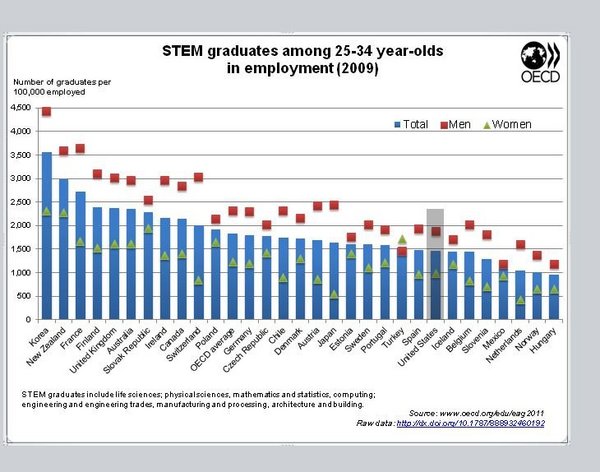
The Organization for Economic Cooperation and Development report on STEM graduates worldwide paints the dismal portrait above of American achievement in which we rank behind 22 other counties in the production of technically trained college graduates.

How that happens in a climate of declining public support for higher education, poor STEM preparation in elementary and secondary schools, low completion rates, and spiraling tuition that locks many in the “99 Percent” out of access remains a mystery to me.

Unless of course we innovate.

Mark Guzdial's avatarComputing Ed Research - Guzdial's Take

Pretty cool!  The latest PCAST (President’s Council of Advisors on Science and Technology) report is on “ENGAGE TO EXCEL: PRODUCING ONE MILLION ADDITIONAL COLLEGE GRADUATES WITH DEGREES IN SCIENCE, TECHNOLOGY, ENGINEERING, AND MATHEMATICS.”  CS Education plays a significant role in this, and SIGCSE gets a few mentions!

View original post