
From the President’s Council of Advisors on Science and Technology:
PCAST found that economic forecasts point to a need for producing, over the next decade, approximately 1 million more college graduates in STEM fields than expected under current assumptions. Fewer than 40% of students who enter college intending to major in a STEM field complete a STEM degree. Merely increasing the retention of STEM majors from 40% to 50% would generate three-quarters of the targeted 1 million additional STEM degrees over the next decade.
PCAST identified five overarching recommendations that it believes can achieve this goal: (1) catalyze widespread adoption of empirically validated teaching practices; (2) advocate and provide support for replacing standard laboratory courses with discovery-based research courses; (3) launch a national experiment in postsecondary mathematics education to address the mathematics-preparation gap; (4) encourage partnerships among stakeholders to diversify pathways to STEM careers; and (5) create a Presidential Council on STEM Education with leadership from the academic and business communities to provide strategic leadership for transformative and sustainable change in STEM undergraduate education.In addition to Mark’s cool factor, this report highlights the need for innovation. There is a now well-documented need for millions of college graduates, and setting the bar at one million may not be enough.
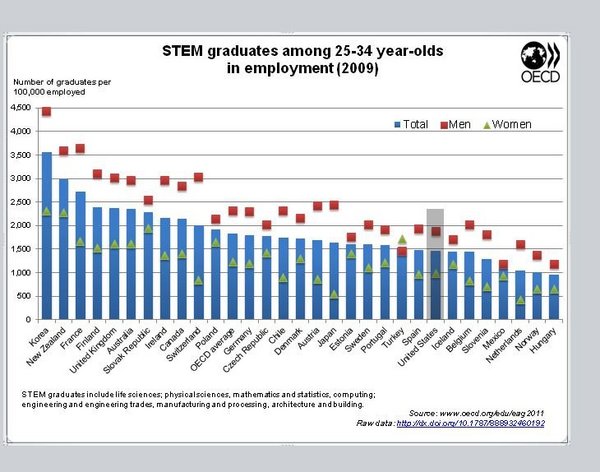
The Organization for Economic Cooperation and Development report on STEM graduates worldwide paints the dismal portrait above of American achievement in which we rank behind 22 other counties in the production of technically trained college graduates.
How that happens in a climate of declining public support for higher education, poor STEM preparation in elementary and secondary schools, low completion rates, and spiraling tuition that locks many in the “99 Percent” out of access remains a mystery to me.
Unless of course we innovate.

Pretty cool! The latest PCAST (President’s Council of Advisors on Science and Technology) report is on “ENGAGE TO EXCEL: PRODUCING ONE MILLION ADDITIONAL COLLEGE GRADUATES WITH DEGREES IN SCIENCE, TECHNOLOGY, ENGINEERING, AND MATHEMATICS.” CS Education plays a significant role in this, and SIGCSE gets a few mentions!



 Innovate.EDU