MOOC platforms are the new startups.  Literally. We are closing in on a half billion dollars pouring into online education companies like Coursera, Udacity, and edX. Tens of millions of dollars are flying out the door of places like MIT, Stanford and U Penn to produce new instructional materials.

Nobody really knows how it will all turn out, but  these are experiments that need to be given time, space, and dollars to to incubate innovation.  But what exactly does that mean?  And what models are available to institutions that want to try to create such safe spaces for innovation?

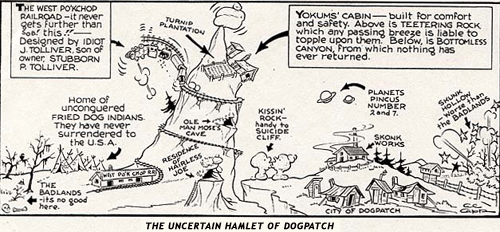
When the residents of Al Capp’s mystical, mythical Uncertain Hamlet of Dogpatch needed to brew up a batch of Kickapoo Joy Juice, they did on the edge of town.  It was a smelly, messy process and the factory was better suited to the environs of Skunk Hollow — “worse than the badlands” — than the otherwise proper City of Dogpatch.  By the way, being worse than the badlands is a real black mark because in the Badlands “it’s no good here.”

The vision of Skonkworks, perched on the edge of Skunk Hollow, belching the byproducts of producing exquisite joy juice has been a metaphor for internal innovation ever since.

The approach at Georgia Tech has been to create an internal laboratory to try things out. Other places have tasked educational technology groups, CETLs, or distance education departments.  They are all  Skunkworks.  Just don’t call them internal startups. That is a sure path to failure.

When it comes to skunkworks, there are ideas to try out and ideas to avoid.  A colleague of mine once started a discussion by saying, “Let’s begin by figuring out what the administration will allow us to do.”  What a terrible idea — a rookie error. It defines your design space by all kinds of parameters that have nothing to do with success.

But it is easy to fall into this kind of trap.  There are plenty of examples of “internal startups” that failed in exactly this way.  It’s not just that online courses at elite campuses are brewing their own brand of joy juice.  New developments like MOOCs exist to bend perceptions and blur boundaries, so using traditional perceptions and boundaries to explore MOOC potential doesn’t make a lot of sense.

I want to repost a series of articles I wrote last year about this topic.   I think the lessons apply to academia.

Next:  The Internal Startup
  • Random conversations at the edX institutions:  “There is no strategic discussion on this campus of the future of higher education.”  A speaker proposing massive changes: “We will all disappear.”
  • The very idea that a study exists to contradict experience draws overt hostility:  discussing Academically Adrift a senior faculty member reports: “I find that [referring to the Arum/Rokser finding that 45% of students show no measurable increase in learning after two years of college] very hard to believe. The students I see as Juniors are measurably better than they were as Freshmen.”
  • Big Idea: Daphne Koller seminar at Georgia Tech:  Benjamin Bloom’s  2 Sigma Problem is  a driver of the Koller/Ng approach to MOOCs.  It has been known for 30 years that the mastery classroom moves who populations by one standard deviation.  1-1 tutoring moves it another, hence “2 Sigma” Why have institutions ignored this result?  It would require abandoning normative testing.  Non-normative assessment is widely thought to depress productivity, but the long-term effects of future failure are not  considered in those calculations.  Bottom line is that the technology enables  a solution to 2 Sigma.  Who will sign up to the obvious challenge?
  • Woody Flowers in the MIT Faculty Newsletter writes about MITx and edX:
    • In edX’s MOOCs (Massive Open Online Courses), I believe we have a product without a strategy. We should design products that help us improve while also helping schools everywhere. MOOCs do neither…
    • I believe MOOCs are a fad. Right now, their purveyors are preoccupied by a race to volume.
    • Collections of inexpensive “course badges” could undermine the value of a diploma and society would realize too late that critical thinking, creativity, and professionalism are not easily adopted or evaluated via a screen. Imagine what state legislatures might do to their state’s college budgets. What would happen to the symbiotic relationship between education and research?
  • Global discussion among higher ed leaders focused on the winner-takes-all aspects of  MOOCs.  There are other possible outcomes because consolidation is not an inevitable consequence of serving new markets.  It seems to me equally likely that there will be a very long tails in which the marginal cost of defining and launching a new, specialized university .
  • How to blend:  the NPR model for online education: 50% highly produced content + 50% local content.
  • As the the Adrift-denying professor mentioned above illustrates it’s a constant struggle between data and how you feel about what’s going on.  How you feel about it has no effect whatsoever.
  • “Education theory is like a toothbrush.  Everybody has one, but nobody wants to use someone else’s.”
  • Merrick Furst in today’s C21U meeting:  “It’s all about value.  If you get that wrong then these discussions [of future scenarios for institutions like Georgia Tech] don’t matter at all.”

OK, so it’s one thing to know what forces are driving tuition increases.  It’s another thing to know where money is being spent.   That is a problem of different proportions because universities do not report their spending in neat categories like

  • cost of scaling beyond capacity
  • making up for lost subsidies
  • cross-subsidies with loss leaders

And, as The Delta Project’s Jane Wellman is  fond of pointing out,  there is no category representing value that ends up on a student’s diploma.

It’s not a completely satisfactory approach, but you can look that the “Where does the money go?” in question in two ways.

The Accounting View

As I pointed out in a previous post, overall spending has not substantially increased — even as tuition has risen.  What has increased is spending in the following categories:

  • institutional grant aid
  • public service and research
  • energy
  • facilities
  • contingent faculty
  • residence hall operations
  • groundskeeping
  • online
  • admin
  • bookstore
  • general staffing
  • financial services

These are interesting categories because increases in these areas generally compensates for decreased spending in others.  Take contingent faculty, for example. Increased spending for part-time or adjunct professors compensates for an overall reduction in tenure-track faculty. Contingent faculty carry  a completely different cost platform.  In many cases health care costs can be trimmed by reducing the number of full-time faculty. adjunct professors do not require expensive startup packages. Capital requirements also change, because office and lab demands are not the same.

This brings us to a second way of tracking dollars: what behaviors result in large shifts in spending priorities.

The Behavioral View

Behaviors are interesting because you can imagine controlling them.  Here are the behaviors that institutions report as affecting their current spending priorities.

  • Making up for lost revenue
  •  Lost productivity
  •  Capital expenditures
  •  Cost of non-core activities
  •  Administrative bloat
  •  Giving it away
  •  Compliance
  •  Health Care and other costs of an aging workforce
  •  Unquantified “quality”
  • Overshooting markets like internationalization
  • Stealing revenue  from academic programs
  • Operational inefficiency
  • High cost of materials
  • inappropriate skills utilization

There are others of course.  Stanford president John Hennessey has recently pointed to labor costs tied to the professorate drive cost increases, but I can’t find anyone who will show me a price increase that is due to increased faculty costs.

I can find examples of capital projects where initial funding plans have collapsed. Few of these projects are drop-dead institutional requirements.  There are a fair number of vanity projects and many examples of non-core activities like athletic practice facilities or mixed-use facilities that were once thought be revenue-producing opportunities but for which a real market never materialized.  When funding profiles change dramatically, one response might be to re-evaluate the need for a new building, but that rarely happens.

This is a true money pit.  There are really only three sources of discretionary revenue: tuition, government allocations, and private gifts. One way to make up for lost revenue is to increase income from other sources.  In most cases, this means tuition.

  • Big idea of the day: Data analytics comes to higher education.  A few things seem to have changed.
    • Scale.  The major players are focused on big data analytics. Beyond mere search.
    • Personalization. RT delivery of an educational experience tailored to learning styles, needs, learning objectives at the level of the individual learner
    • Granularity. Candace Thille (http://www.cmu.edu/teaching/ote/WhoWeAre/index.html) calls it Nano-Scale data collection. Knewton’s Jose Ferreira talks about Atomic Concepts.
    • Cannot allow data monopolies.  Stovepipes are unacceptable.  Open sharing and interchange standards are essential.
    • Jose Ferreira: Knewton’s capturing in the hundreds of thousands of data per user per day. We’re capturing what you’re getting right, what you’re getting wrong, what answers you’re falling for if you get something wrong, what concepts are in that answer choice that you’re falling for. We’re also capturing when you log into the system; how much you do; what tasks you do; what you don’t do; what was recommended that you do that you didn’t do, and vice versa. Your time on task for every little task, whether it’s reading something or doing a practice question or watching something. Your click rate—how fast you’re clicking on stuff. You can imagine one student accessing different material. If her click rate increases between math and verbal—maybe she’s going through the verbal a little faster—maybe it’s a little easier for her. (http://chronicle.com/article/A-Conversation-With-2/132953/)
  • Shifting from an institution-centered view to a student-centered view. How will we shift processes, assessments, credentials, identities to track learners through out their lives? Sebastian Thrun observes that learners’ lives have changed.
    • Old: short period of education followed by long period of work
    • New: learning, reinvention, work intertwined
  • Along the lines of big data:  Noodle is a cradle-to-grave education recommendation engine. “We’ve created a dynamic recommendation engine that will deliver highly compatible and personalized search for ‘best-fit’ education solutions,” (http://edtechdigest.wordpress.com/2012/03/16/interview-using-your-noodle-with-joe-morgan/) 2Tor’s John Katzman is Chairman.

  • Online debate raging at Georgia Tech regarding “Why we should rule MOOCs, and how” — email thread among CS faculty is now a week old and involves nearly 30 faculty members on all sides of the issue.
  • Education Sec. Arne Duncan kicks off invited symposium of leaders in higher ed innovation at meeting designed to drive productivity in postsecondary education
    • Duncan will ask for commitments in areas like creating sustainable faculty buy-in, MOOCs, and predictive analytics
    • 175 attendees selected by Dept of Ed and WH OSTP who are jointly sponsoring the event
    • Represented — Coursera, Udacity, eDx.  Also @openstudy, @C21U and others.
    • Call to action will result –stay tuned.
    • Move from islands of excellence to systems.
    • Duncan acknowledged pros and cons for MOOCs but also said classes with tens of thousands of students are something new and you can’t ignore new things.  At the very least this kind of scale was not happening five years ago.
    • Watch #higheredinn
  • Essential reading:  Ithaka report (barriers-to-adoption-of-online-learning-systems-in-us-higher-education) co-authored by former Princeton President Bill Bowen: Barriers to Adoption of Online Learning in US Higher Education
  • Deadline for Bill and Melinda Gates Foundation proposals aimed at bending the cost curve in the first two years of college using MOOCs. 20 courses account for most of the cost and there may be more efficient, more effective delivery models.
  • When will accreditors take another look at online delivery? Online universities like WGU have been at it for awhile, but open courseware presents new challenges.  There will be announcements over the next few weeks.
  • Online universities teach down to their students. Overheard at one of the prominent online universities: Let’s select a degree name and then see if we can fit it into the envelope that we think represents our students. Too much math? No problem, we can just get rid of it because our students will never be able to handle it.
  • Big idea of the day:  Everyone is talking about about bending the cost curves by getting 80% of education for 50% of the cost.  Question — can we get 120% of education (measure the outcomes however you wish) for 80% of the current cost?  This is a different kind of challenge and it cannot even be framed without fundamentally rethinking how we structure and deliver educational experiences.  It almost surely requires technology to mediate it. Hal Plotkin (#higheredinno) made the point earlier today.  With technology the “you can’ts are different.”