Archive

Resources

The latest economic parable explaining why tuition at American colleges and universities has risen twice as fast as health care costs is aimed at supporting an insupportable value proposition: a university education is cheap at twice the price.  In my last post I talked about the danger to higher education in “clinging to myths”, as MIT’s John Curry put it.  Justifying the high cost of a college education rests on one of those myths.

Here is the basis of the economic argument: since college costs are driven by labor intensive processes that require high degrees of skill and are resistant to technological efficiencies, we should look to the value received in other specialized service markets like health care and banking where quality demands 1-1 contact with a highly trained service provider. The conclusion is that higher ed prices have fared no worse than prices in those other markets. Some of the comments to my last post also repeated this argument.

The problem with this line of thought is that virtually none of the assumptions underlying it are true.  Never mind that wholesale “mission creep” has systematically siphoned off value that should be delivered to students in the classroom in favor of dozens of other priorities. The basic underpinnings of the things-aren’t-so-bad argument are simply fabricated.

Running a university is like running a business.  There are denyers who dispute that claim, but the fact of the matter is that in higher education income has to balance expenses.  If expenses rise, then a university president has to search for new sources of income.  State subsidies are drying up. Endowment income has been shrinking. Research income does not help, and licensing income is, well, let’s just say it’s an unlikely source. The only source of new income is tuition, and the parable concludes by saying,  “Labor costs are high, so let’s get students to subsidize the increase.”

There are not that many different ways to bring costs down in any business: (1) you can deskill your workforce, (2) you can find a more efficient physical plant, or (3) you can use materials better.  There is no reason that a higher quality university education cannot be delivered to more people by applying one or more of these principles.

Let’s take on the we-must-use-high-cost-labor assumption. Even if you are not a believer in online education, only a stunningly short-sighted point of view  fails to recognize that ed tech is on a different innovation curve than classroom instruction. Compare the improvement in the educational blogging experience over the last six months with the rate of change in the classroom, where it can be argued that the last real technological innovation–one that became ubiquitous because of its obvious value–was the introduction of the chalk board in 1801.

I understand the thesis: university teaching cannot be deskilled because it is by definition undeskillable.  Higher education is artisinal by its very nature.  It has to be delivered by professors to individual students–or, at least, to small groups of individuals–in person. I agree with that:  given the premise of an artisinal workforce, deskilling makes little sense.  If we do nothing at all to change what and how we teach then what we have today is probably pretty close to the best that we can expect from the system.  But I reject the premise out of hand. Which brings me to a very different way of looking at the economics of higher education: the parable of  tip and ring.

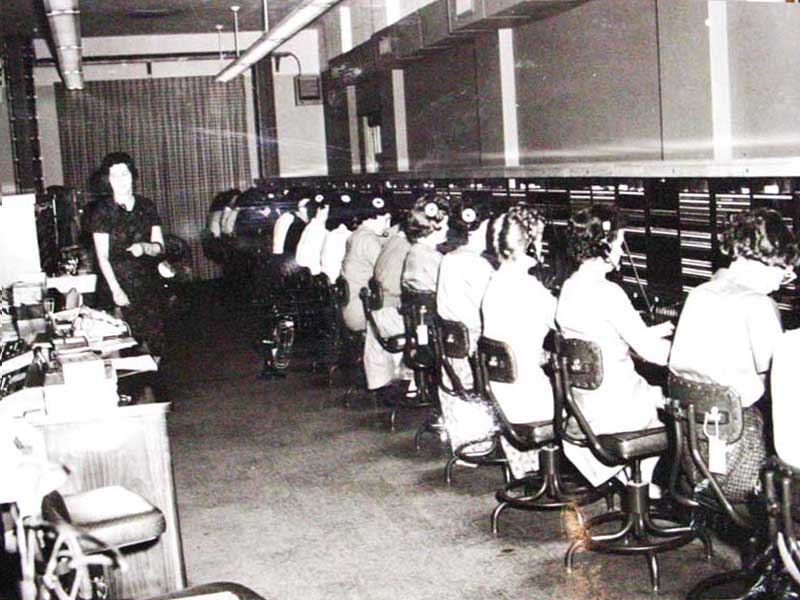
Tip and ring is the technology that telephone operators used to manually switch telephone connections a hundred years ago. The tip and the ring of the plugs that operators used kept the twisted pair of copper wires in a telephone cable separated so that they could be inserted into the large patch panels of a central exchange switch.

Early studies of telephone operator efficiency by Western Electric indicated that a skilled worker at peak performance could switch up to 250 calls at one time. Everyone did the math.  Given projected population growth and even the most conservative estimates for network growth, the current method of switching was going to be very expensive.  Underlying labor costs would limit the extent to which Americans would have direct access to telephone communications. An investment banker in 1887, summarized the various Bell System technical memos on the subject very succinctly:

The possibilities of a private home telephone system throughout the country is out of the question. Almost the entire working population of the United States would be needed to switch cable.

Network engineers were aware of the current economic curve and a few brave souls piped up: “Well, what if we do things differently? What if we replace the human telephone operators with automated workings? Wouldn’t we be able to multiply the number of switching operations per minute by many fold?”  By 1918, rumors of the promise of deskilling in voice telephony reached the office of Theodore N. Vail, president of American Telephone & Telegraph:

Automated working is not adapted to our needs, any more than radiography will will ever supplant telegraphy by wires.

Human operators were eventually helped out by some technology, but it wasn’t until the first crossbar switch was installed in Brooklyn, New York, in 1938 that automation began in earnest.  It took a hundred years for the U.S. telephone systems to reach 700 million installed lines. In the next ten years, the number of lines doubled, while technology put voice call quality on its current growth curve. By 1986, fiber optic technology enabled Sprint to revolutionize the long distance telephone business with its “So clear you can hear a pin drop” marketing campaign. None of this would have happened if Theodore Vail had  his way and the telephone business had remained dependent on a highly skilled manual workforce to switch voice calls.

So, yes: if higher education remains dependent on the tip and ring process of using an unnecessarily labor intensive system, costs will continue to rise. There are many–perhaps a majority–in higher ed circles who would repeat Vail’s dictum: “Automated working is not adapted to our needs.” To be more precise, they say, “Higher Education remains essentially an artisinal industry.” There are others, however, who believe that fundamental change will not only bring costs down, it will bring the 1986 promise of pin drop quality to the 21st century university. And don’t get me started about how wrong Vail was about mobile telephony.


In Where’s the money….? I described for you the Department of Education’s assessment of the financial health of the nation’s private universities:

The U.S. Department of Education issues a regular report on the financial health of  degree-granting colleges and universities.  It is a sort of test of financial strength.  When I started tracking the course of these institutions for my book, there were about a hundred non-profit colleges  that failed the test.  By 2008, that number had risen to 127.  The Chronicle of Higher Education has just reported that 150 non-profits now fail the Education Department’s test.

Now we have picture of the toll that the financial meltdown and runaway expenses are exacting on America’s public institutions as well. Moody’s Investor Services has just issued its report on the liquidity of public universities: “U.S. Public University Medians for Fiscal Year 2009 Show Tuition Pricing Power Amidst Rising Challenges.”  The report is available only to Moody subscribers, but Goldie Blumenstyk, writing in today’s Chronicle of Higher Education, summarizes the key findings as follows:

The median level of debt for 200-plus public institutions rated by Moody’s—$176.9-million as of the end of the 2009 fiscal year—has grown by 31 percent over four years. That’s notably greater than the rate of revenue growth (25 percent), total financial resource growth (15 percent), and enrollment growth (13 percent) during that same period…For the first time, colleges’ debt per student ($13,665) exceeded their financial resources per student ($12,893).

As a consequence, operating margins are at or near all-time lows for public institutions and are negative for many.

Tuition is rising at many public universities, but the cost to students is not being converted to increased educational value.  In many cases, tuition increases simply service expanding debt obligations. While the liquidity of top-ranked public research universities is worse than their private top-ranked counterparts, the public medians have the ability to convert a larger share of their assets to cash in the near term.  What Moody’s doesn’t say is where the liquid cash comes from.

The lack of transparency in public funding of higher education matters.  A public university has a public budget, and we all know that in most states funds slosh back and forth between spending categories without regard to the rules of arithmetic that most of us have to live under.

One large eastern state delayed paying university employees until the start of the next fiscal year.  Another one routinely delays most raises until the start of the next calendar year.  Still another allows cash to flow freely between major athletic programs and major academic obligations in the hope that a great athletic season might generate enough private donation to repay internal mortgages. Cost-sharing contributions are shifted, research cost recovery is murky, and personnel obligations are sometimes backloaded for months and years.

Even in good times, generating cash for operations in a public university is an exercise in juggling future payments.  With zero operating margins, administrators are the unlucky Monopoly™ player who has just landed on Park Place and realizes that the only way to pay the rent on the three hotels is to mortgage all of his properties. He spends the rest of the game hoping that he can keep his meager wages. Hope is not a strategy.

That is why the ability to raise tuition is so powerful.  But, as Moody’s new report makes clear, tuition increases are like passing GO.  New tuition dollars fill budget gaps. They do not change a university’s finances. It is only a matter of time before students figure that out and go for the e-pill.

Matthew Denhart and Christopher Matgouranis write on the August 19 blog of the Center for College Affordability and Productivity (CCAP):

The only way to judge the how worthwhile an investment, is to know the marginal benefits that result from it compared to its initial cost.

Based on these criteria, it is clear that the public is largely in the dark as to the value of a college degree. As we discuss in an article for Forbes.com today, colleges and universities rarely collect and publish information about the outcomes of their graduates. Perhaps this is an area where the U.S. Department of Education should step in and require alumni information be gathered and presented to the public in a clear and coherent manner. This would go lengths at providing the transparency and accountability in higher education that would benefit students and taxpayers at large.

The full text of their article can be found at Forbes.com.

In case you were wondering whether factoring value into reputational rankings of colleges and universities would change things, the answer is yes.  CCAP publishes an annual ranking of undergraduate colleges based on value.  The top of the list may not be a big surprise.  Williams College is the top ranked institution.  Princeton is second.  MIT and Stanford are in the top ten.  But so is Claremont McKenna College (9). Some Ivies don’t make the top fifty (Cornell is ranked number 70).  Georgia Tech ends up way down the list (242), a few positions ahead of Ohio State, but well out in front of the University of Arizona (339) and the University of Minnesota  (418).

Not surprisingly, the CCAP/Forbes rankings have generated heated — some might say enthusiastic — responses that either decry the irresponsibility of Forbes editors for publishing an obviously flawed ranking or agree  “it’s about time..” that Middlebury (26), Bowdoin (40), and the U.S. Naval Academy (29) get the recognition they deserve.  Research institutions — particularly those with high per-student expenditures — populate the bottom of the list in alarming numbers.  On  the other hand, student and alumni approval improves a school’s rank.

One reading of the CCAP article is that ephemeralization is overdue since American higher education seems incapable of doing more with more. I’ll let you take a look at the rankings and come to your own conclusions.

I’ve been writing about the financial stability of seemingly solid institutions:  the hundreds of colleges and universities in the Middle.  What exactly is the Middle?  It’s the great swath sandwiched between the seventy or so Elite universities that have amassed the resources to set their own directions and a handful of For-Profits, the proprietary institutions that are able to grow income and profits while serving an increasingly larger share of the American market for higher education.  The Elites have brands that will carry them through financial storms.  The For-Profits have a plan.

A growing number of institutions in the Middle see a bubble of  increased costs, declining enrollments and vanishing endowments.  Like Frank Capra’s George Bailey in It’s a Wonderful Life , they are looking for an Uncle Billy to rail at: “Where’s the money, you stupid old fool?

Any one who doubts that the Middle sits precariously atop an economic bubble has not been following events closely enough. The U.S. Department of Education issues a regular report on the financial health of  degree-granting colleges and universities.  It is a sort of test of financial strength.  When I started tracking the course of these institutions for my book, there were about a hundred non-profit colleges  that failed the test.  By 2008, that number had risen to 127.  The Chronicle of Higher Education has just reported that 150 non-profits now fail the Education Department’s test.  That certainly looks like a trend.  In that same period, the number of failing For-Profits actually fell.

There are some venerable institutions on the list, but that is not surprising. Venerable institutions can fail.  The death in 2007 of  Antioch College — the university founded in 1852 by Horace Mann — was announced in an obituary masquerading as an op-ed piece in the New York Times. I remember Antioch in the 1960s as a thriving haven of liberal thought.  At the height of its popularity it enrolled nearly three thousand students.  Coretta Scott King was an alumna, and her sister was the first African-American admitted to its fully integrated curriculum. Who would have thought that Horace Mann’s college, guided by his admonition  to every graduating class to “be ashamed to die until you have won some victory for humanity, ”  could quietly wink out of existence with an enrollment of two hundred students and an endowment of less than five million dollars?  Not every school on the 2009 list is destined for extinction. Some will tighten their belts, rethink their value and pull through.  Some will be purchased by For-Profit universities.  Some, like Antioch, will simply die.

Officials of some of the schools on Department of Education list claim with complete deadpan candor that they are victims of a collapsing market that undermined their financial strength. It’s probably true, but those officials need to talk to the executives at Lehman Brothers to understand how little it matters.

Here’s the scary thing.  There are no public institutions on the list.  That’s not because public universities are uniformly healthier than their private counterparts. In fact, the finances of public institutions are uniformly opaque. It’s hard to tell whether they are financially sound or not.  Public support for a university means that the Education Department does not test financial strength.  Public universities are too big to fail.

The plan for the Middle — public and private —  seems to be to ask, “Where’s the money?”   George Bailey had a plan to stave off the run on his Building and Loan Association. His plan was to demonstrate that his bank had value that small homeowners could not get anywhere else:

You’re thinking of this place all wrong. As if I had the money back in a safe. The money’s not here. Your money’s in Joe’s house…right next to yours. And in the Kennedy house, and Mrs. Macklin’s house, and a hundred others. Why, you’re lending them the money to build, and then, they’re going to pay it back to you as best they can.

Better than screaming at Uncle Billy.

Let’s imagine a pill. I’ll call it e-pill. It’s available to every young adult who wants it — probably a benefit of some program to link health care and education.  E-pill has one effect: it permanently rewires brains to store, understand and effectively use knowledge equivalent to the general education requirements at a good American university. You know what courses I am talking about: science, math, history, philosophy, art, social science, writing, and literature. No side effects.  It does not make you any smarter, but if you’ve taken e-pill, you have a lock on credit for English 101 and Intro to American History.  No downside to the pill at all except for this:  you have to forgo the classroom experience.

Thinking about e-pill  clarifies something that has been on my mind a lot these days: ephemeralization of American colleges and universities.  Ephemeralization is a term that Buckminster Fuller  used to capture the economic concept of dematerialization.  In effect, ephemeralization means doing more with less.

The National Conference of  of State Legislatures just issued a report that makes it clear the extent to which public universities will have to do more with less over the next several years. According to State Higher Education Executive Officers:

Appropriations per student remained lower in FY 2009 (in constant dollars) than in most years
since FY 1980.

Tuition increases — which now average 37% of revenues — have made up for some of the shortfall, but as Delta Project data makes clear, although increased tuition may cover lost revenue, it does not necessarily find its way into instructional budgets.  Public institutions have been using stimulus funds provided by the 2009 Federal American Recovery and Reinvestment Act (ARRA) to keep the wheels on.  ARRA funds will disappear soon. All the while, students are pouring into dozens of campuses like the University of Central Florida where access is paramount.

The lead article in today’s Chronicle of Higher Education, was a jaw-dropping summary of the budget shortfalls awaiting the State University System of New York and other systems where state finances are so broken that higher education funding will be disastrously inadequate for years. Maybe decades. Short of rolling over and shedding both students and programs, dematerialization is the order of the day for most of us in public universities.

As I pointed out in last week’s post, there are swirling financial misconceptions that — if acted upon — could actually make matters worse.  This is not the time, for example, for an aspiring public institution to undertake a large research commitment in the blind hope that research revenue would help the budget.

What does this have to do with e-pill?  This is a time to take a serious look at the value proposition for American universities.  If there is a way to get the unnecessary cost out of the general education requirements, it would have an enormous impact on the economics of running a public institution.  Universities — particularly research universities — are under-reimbursed for the cost of offering courses that do not need to be taught in the traditional , expensive, bricks-and-mortar way.  I mentioned the University of Central Florida above, because as the third largest university in the country, they have already shifted a substantial portion of their introductory load to online delivery — not exactly an e-pill, but the marginal cost per student in an online course is a tiny fraction of the cost for campus-based delivery.

If the marginal cost were actually zero (the e-pill scenario), then what would be the rationale for charging anything for the first two years of a university education?  The argument that was made shortly after the American Civil War was that the social experience of attending a university was worth the price of admission.  It was not a winning argument, and the structure of higher education in the U.S. was forever changed as a result.

The experiment should be easy enough to run.  Let’s set two prices.  The first price, a nominal fee, reflects the true cost of the general ed requirements when they are offered efficiently using modern technology — costs that are unburdened by subsidies to research, athletics, and bureaucratic offices that add little value to a student’s education.  The second price — the deluxe treatment — reflects the true cost of the on-campus experience. Virtually all of the value for the high price on campus experience is from activity outside the classroom, and  because there has been an effective dematerialization for English 101, the income from families who have the wherewithal  to pay for first-class tickets can be applied to other institutional priorities.  Maybe even the upper division courses where smaller class sizes and dedicated instructional budgets might have a beneficial impact on a student’s education.

Vendors of proprietary Unix™ servers had to face this same problem a decade ago.  Why would a customer pay the high-margin premium prices for HP-UX™, Solaris™, or AIX™, when there was a “free” alternative?  The answer, it turned out, was that customers paid for value. The smart companies figured out that the high-margin, high-expense proprietary Unix business was different from the low-margin open source business. Smart companies figured out how to make both businesses work.

This is the opportunity for ephemeralization.  Since doing more with less is inevitable, why not turn our attention to it?  We will never get an e-pill, but we might be able to squeeze half the cost out of the rapidly commoditizing general education requirements.

The question for public universities is what to do when the crossover point is reached —  when the value to students exceeds the cost of delivery.  I asked Arizona State president Michael Crow exactly this question, and,  without skipping a beat, he told me he would like to do: “Let’s figure out what we are the best at, and make that available to as many students as possible. If ephemeralization is inevitable, what other value propositions change what universities will look like when we reach the crossover point?