Archive

Policy

It’s one of my favorites. Tom Wolfe’s  June 8, 1970 New York Magazine article “Radical Chic: The Party at Lenny’s” is a dazzling piece of writing that never fails to alternatively enrage and inspire as layer by painful layer the dangers of “integrating new politics with tried and true social motifs…” are laid bare.  More than an essay, it’s a universal metaphor.

Everyone from the Black Panther anarchists who were guests in the Bernstein house (but apparently thought that his was the BERN-STEEN residence)  to Peter Duchin’s wife Charay (who bubbled “I’ve never met a Panther before–this is a first for me!”) comes away excoriated and diminished. Including Tom Wolfe.

My favorite passage is the brief exchange between Leonard Bernstein and Panther field marshal Don Cox:

“You can’t blueprint the future,” says Cox. “You mean you’re just going to wing it?” says Lenny.

It’s that way with every revolution, I suspect.  Events are set in motion. If they are dangerous enough, they attract attention and sometimes even smug support from fashionistas who cannot quite believe that outcomes are uncertain. Edupunk is like that. It’s an idea that sounds dangerous but somehow containable.  Flying close to that flame might actually be fun.

At least that’s what University of Virginia president Teresa Sullivan probably had in mind when

In a bow to the “Edupunks,” Sullivan explained that Virginia is incorporating student habits into its pedagogy.

“Radical Chic” came immediately to mind when she explained that a bow can be as cheap and impersonal as a $500 check at Lenny’s dinner party.   It’s  not exactly the  Jeffersonian embrace that you might expect from an institution like Virginia:

“flash seminars” alert students to an edgy topic — no examples of how edgy — that will be discussed in a professor’s living room. To raise the hype level, only the first 25 students who show up are allowed to participate in this non-credit-bearing activity.

A colleague of mine put an even finer point on the comparison:

“bow”,”hype level”, professor’s “living rooms”, “edgy topics”– the academy domesticates  the “bizarre acts” of flash behavior, clueless to its naffness.

It should come as no surprise to those of you who saw last week’s announcement or have been following the plans that Richard Barke, Bill Rouse and I have for an open seminar on “Transforming Academia” at Georgia Tech’s Tennenbaum Institute that that I am winding up the year thinking about big ideas in higher education.

In fact, right after Georgia Tech announced the creation of a Center for 21st Century Universities (C21U), I started getting phone calls and email. “What’s the point?” one writer said. “Won’t universities change over the next 40 years or so?”  “What’s your vision for the 21st Century?” asked one reporter. “Here’s an idea that you have to look at,” said a colleague.  “It will change everything.”  The whole point of C21U is that over a hundred years, everything will change, and–from our vantage point at the start of the century–we have no way of knowing which ideas matter.

There is one thing that history teaches us: the ideas we think are important and radical  and chic today have almost nothing to do with how things turn out. I thought it was fascinating that the first questions I got about C21U were the ones that Arthur Miller and Barbara Walters were asking at the Lenny’s the night that Cox, Miller, and the other “funky, natural, scraggly, wild…” representatives of a new order stepped into polite society.

Would a turn-of-the-last-century gathering of influencers actually recognize the ideas that would shape higher education over the next hundred years? The New Year is an occasion for lists, so here’s one: What are the three ideas that shaped higher education–for better or worse– in the 20th Century?

Why only three? After all, higher education went through massive changes from 1901 to 2000.  But I would argue that these changes were consequences of three big ideas.

  1. The University as a Factory: The first massive increase in funding for higher education came from John D. Rockefeller and Andrew Carnegie. They transformed American universities, but the great philanthropists were also industrialists.  They demanded that the chaos and debris of 19th century experimentation be swept away and replaced by fiscal and administrative discipline. The chaos was tamed, but the price was the creation of an institution that took in raw materials of a measurable grade and under the watchful eyes of managers and boards of directors produced graduates of a certain intellectual size and shape. Everything from standardized admissions testing, an obsession with measuring inputs, and a focus on classroom efficiencies to the layers of bureaucracy for administering an unwieldy system of accreditation stems from the demand of  philanthropic foundations that universities operate with factory-like discipline.
  2. The National Science Foundation: Before Vannevar Bush convinced Roosevelt and Truman to create a  taxpayer-supported, national version of the Carnegie Foundation, sponsored research played essentially no role in university operations. Over the next sixty years, the rate of  federal spending on university research rose nearly three times faster than the economy as a whole. NSF led the first explosion in federal funding, and it cause a shift in values at the nation’s universities that forever coupled scholarship with sponsored research.  The very idea of a research university was transformed in the process, and it soon engulfed the social sciences and the humanities in a new  multi-billion dollar industry that–in addition to the elite research universities–now reaches into the thousands of regional and community colleges whose missions have expanded to include research.
  3. The Multiversity: It was legendary University of California president Clark Kerr who observed in his 1963 lectures at Harvard that universities were no longer single communities, but had become the sometimes inconsistent homes to stakeholders who did not always share the same goals but needed to be supported and nurtured if the university in the 2oth century was to play the same national role that railroads did in the 19th century. Graduate and undergraduate education had to survive and prosper with medical and other professional schools, athletics, the arts and others. The idea of a multiversity coincided with the second great influx of money into higher education. Some say it was instrumental in the decline of the great public universities and the creeping missions of all institutions. At least in was the cause for abandoning forever the idea that money spent in the nation’s colleges and universities should end up in the classroom.

Nobody would have recognized these as the great ideas of the coming decades.  There would have been no Edupunk thrill in rubbing elbows with the bureaucrats who defined the “Carnegie unit ” or a future MIT dean who believed that scientific talent was a national treasure. The great institutions were as likely to be state universities–which were still small and wealthy–as private colleges.  Not one of the public universities on Raymond Hugh’s 1925 list of top 20 research universities is at the top of the  current U.S. News and World Report ranking of graduate programs. They were displaced by universities that did not even exist in 1901.

Before pulling out their checkbooks to support the new politics of higher education,  radical chic party guests would have wanted to know what the plan was. Clark Kerr would have told Lenny, “You can’t blueprint the future.”

Lenny would have been incredulous: “You mean you’re just going to wing it?”


One of the commercials broadcast during the NBC Monday Night  Movie on the evening of September 7, 1964 was a one-minute campaign ad for President Lyndon Johnson.  It began innocently enough with a child picking daisies and ended in the horrifying nuclear catastrophe that would be the inevitable result of electing Johnson’s Republican opponent, Barry Goldwater.  Johnson’s voice intoned: “These are the stakes!”

The Daisy Ad was broadcast only once, but it was in the view of many historians the decisive factor in Johnson’s landslide victory. Goldwater was at the time a sitting two-term United State senator and the rock-solid leader of American conservatives.  He was a fierce opponent of Roosevelt-era programs,which he considered financially irresponsible, but he was by all accounts anything but excitable.  Nevertheless, the Daisy Ad defined Barry Goldwater as the man who would recklessly plunge the nation into nuclear war. It was a dramatic illustration of the ruination awaiting public figures who allow their opponents to define them.

The number of “These are the stakes!” portents of disaster for American Universities is on the rise. Everything from tenure to the economic benefits of a university degree seems to be under assault.  Richard Vetter, Director of the Center for College Affordability and Productivity (CCAP),says that an economic nuclear wasteland is the price of ignoring the recklessness of American higher education:

The pell-mell investment in sheepskins is beginning to look an awful lot like something our economy has seen in real estate: a debt-fueled asset bubble. It might end just as badly.

How do American universities respond? Meekly. As reported in the Chronicle of Higher Education, university leadership has been slow to recognize the direction and force of prevailing winds.  A common mistake in business and politics is to focus on the feel-good stuff that is ultimately valueless, and universities are making the same mistake.  The Chronicle reports that former MIT vice president John Curry told a gathering of heads of public universities to stop clinging to “worn out myths about campus strengths.” Curry told the group, “We like our stories more than the truth.” That leaves a vacuum for others to tell their versions of the truth.  It was devastating to Goldwater and it will be devastating to higher education.

The CCAP has in recent months published a series of highly critical studies of cost and value in American higher education.  I have mentioned some of them here. CCAP themes have gone viral in communities that are to all appearances unfriendly to the overall goals of higher education, among them the conservative think tank The Heritage Foundation.

It is no secret that conservative groups are increasingly cool to the idea of an academic meritocracy, preferring to view the inevitable hub-and-spoke network of influencers within the academic community as unfair to arguments and causes that would draw relatively few advocates on their own merits–a “liberal tilt” they call it. Now CCAP’s Matthew Denhart has published a study for the Heritage Foundation that argues for less federal involvement in higher education.

You see where this is going. Taking themes that are deeply troubling to the future of universities, like the overreaching of accreditation agencies, and constructing a “Picking Daisies” story about the politicization of higher education, the silence of university leadership becomes the Goldwater response to the doomsday ad. Here’s an example of the disconnect. On my campus, as on many others, there is still serious debate about the use of online education.  We cling to the worn out myths about the value of classroom attendance when overall enrollments are growing at a paltry 2%. The most recent Sloan Survey of Online Education reports that during that same period online enrollments surged by 21%.  I did not drop a decimate point. That’s a factor of ten difference. It sounds to me a little like debating the desirability of damp weather as a tsunami is approaching.

Among the Sloan findings: class differences caused by increasing selectivity and rising costs in traditional public universities are driving a new generation of students toward online learning in unprecedented numbers. The unresponsiveness of public institutions to obvious trends like these clears the way for anyone who wants to define higher ed. What are traditional universities doing in the meanwhile?  We argue about the effectiveness of increasingly baroque systems of ranking our own hubris-driven reputations, we fight tooth-and-nail against a level playing field for traditional and for-profit universities, we are able to argue with a straight face that college costs that have rise at twice the rate of health care costs are not really out of control.

The general public does not care about any of this.  It’s no wonder that they have tuned out pleas for more funding and are willing to turn their backs on a great engine of wealth creation in favor of just about any story that makes sense to them. Richard Vetter’s story is that traditional higher education is the Goldwater who threatens the innocent daisy-picking American public.  It doesn’t make much sense, but it’s better than the story that we tell.

One of the strongest arguments for shoring up the nation’s public universities, increasing graduate offerings, and expanding the role of expansive research plans in determining institutional priorities is the effect that investments like these have on America’s ability to innovate. It’s an argument that rings true, but as facts accumulate, it is beginning to look like public universities are not doing much to secure the future of innovation in the United States.

The nation’s supply of scientists and engineers is fed by a pipeline that extends from the undergraduate programs of colleges and universities to the graduate programs that educate the next generation of PhDs.  The massive investment in research at public universities should have had some impact on the health of this pipeline, but it has not.

A couple of weeks ago, I cited a depressing  CCAP ranking of universities that placed many of the country’s most highly respected research universities near the bottom of value-oriented rankings.  Now there is a new survey from UCLA’s Higher Education Research Institute that adds more details to this portrait of failed priorities.

On a per capita basis the schools whose undergraduate programs are responsible for the most PhDs in the STEM (Science, Technology, Engineering, Math) disciplines are the ones that are also highly regarded by students and alumni for the value they deliver.  There are only three public institutions in the top fifty: UC Berkeley (39), William and Mary (45), and a surprisingly strong 15th place showing for tiny New Mexico Tech.  Who is at the top? Caltech is number 1.  Private research universities like MIT, Princeton, and Chicago are also in the top ten. But so are schools with virtually no research funding.  Harvey Mudd is ranked number 2.  Reed, Swarthmore, and Carleton — all liberal arts colleges — are among the top ten as well. Many in the top fifty are small, but there are a couple of  large institutions like Berkeley (35,000) and Cornell (21,000).  About half enroll between 10,000 and 15,000 students.  All are highly selective, but so are the most of the public universities that are members of the AAU.

In a recent post, I asked “Why universities do research?”  This data makes the question even more pointed. The largest consumers of federal research dollars should be directing their energies to insuring the health of the STEM research pipeline.  All of the schools in the top fifty manage to do it — some with little or no help from the federal government.  So it makes perfect sense to ask what is going on at the other institutions.  I have my own ideas — and I talk about them in my book — but I am also interested in hearing your thoughts.  Is this another indication of a damaged pipeline?

There’s a kerfuffle on the eve of the United Nations Climate Change Conference in Copenhagen. 1,700 email messages  that were supposed to be stored on a secure server somehow found their way to open servers and were rapidly picked up by bloggers and others, who jumped on the opportunity to use the sometimes embarrassing messages to discredit  the overwhelming consensus of climate scientists that the earth is warming at an alarming rate and that human activity is the most likely cause. Aside from the shocking coincidence of events — what are the chances that a massive, worldwide fraud would be exposed at the same time the conspirators are getting together to impose their new world order? — and the uproar among climate scientists — who are launching ad-hominem attacks at every skeptic who pokes his head above ground — are there other lessons to be drawn from this shameless bit of theater?  My Georgia Tech colleague, climate scientist Judith Curry, hit the nail on the head when she  pointed out that: (1) there is really nothing in the released messages that discredits published scientific results and (2) scientists are being incredibly counterproductive by retreating into their Ivory Towers and passing up the opportunity to educate and engage both skeptics and the public.  Her Open Letter to Graduate Students and Young Scientists should be required reading for everyone interested in how to keep worlds from colliding:

…even if the hacked emails from HADCRU end up to be much ado about nothing in the context of any actual misfeasance that impacts the climate data records, the damage to the public credibility of climate research is likely to be significant. In my opinion, there are two broader issues raised by these emails that are impeding the public credibility of climate research: lack of transparency in climate data, and “tribalism” in some segments of the climate research community that is impeding peer review and the assessment process.

For “climate science” you can substitute “innovation” and the message is the same. If you’ve circled the wagons and are shooting at anything that moves, the easy target is public understanding of not only science but innovation in general.  The American public is not interested in the long-term thinking required to make sense out of squabbles like this. There are simply not enough people like San Diego Florist Steve Boigon, who — according to the New York Times — downloads MIT physics lectures because he  finds that:

I walk with a new spring in my step and I look at life through physics-colored eyes.

Curry did not go after the easy targets. Instead, she talked honestly to students about the importance of climbing down from the Ivory Tower. The interactive relationship between basic science, technological innovation and public policy — what Donald Stokes calls Pasteur’s Quandrant —  is a hot topic these days, because  so many important societal issues can only be resolved at their intersection.

There’s a veil that conceals the inner workings of creative science and engineering  from the lay public, and attempts to lift it sometimes produce  bizarre reactions.  I was once struck speechless  at an all-hands meeting when one of my engineers stood to scold  the  CEO for making product decisions because he knew “nothing about electronics.”  A prominent member of my Board of Advisers at the National Science Foundation once countered criticism of his particularly cumbersome approach to software development by angrily proclaiming,  “Programming is like playing a piano.  Only virtuosos should do it!”  A world-renowned engineer once responded to an essay critical of his methods by widely distributing a letter entitled “On a Political Pamphlet from the Middle Ages.”  I was one of the young authors who was at the receiving end of that one.  When  outsiders try to lift the veil, the best course is to repair to the upper reaches of the Ivory Tower, hope that the hubbub goes away, and shoot down if it doesn’t.

It is a world view that is somehow wired into university training. The Medieval regalia, semi-religious icons,  and murmured  incantations that convey special status on the conferees reinforce the impression at every college commencement that something mystical has taken place. Science textbooks are uniformly silent on how science is done, presenting instead the subject as a linear, completed work — orderly in progression and tidy in its use of knowledge.  Nearly every engineering textbook guides  readers through well-rehearsed exercises to successful completion of design tasks. Why would anyone want to learn how to build a bridge that falls down?

Insiders, of course, know differently. What takes place behind the curtain is as important as the finished product.  Some of the best technical books ever written lift the veil.  Proofs and Refutations by Imre Lakatos describes  the centuries-long frustration of mathematicians  trying — and repeatedly failing —  to precisely define polyhedra.  The process led some of  the greatest mathematical results of all time. Why Buildings Fall Down by Mario Salvatori and To Engineer is Human by Henry Petrosky are both compelling arguments that progress in  engineering is inextricably tied to understanding engineering failure.  Insiders know that failure is part of the package.  That’s exactly what makes the most outrageous of the climate change attacks so improbable.

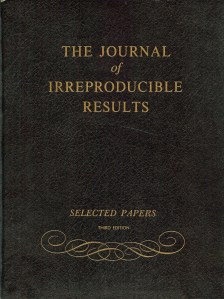
There is a sub-genre of humor devoted to obvious, boundlessly incompetent scientific failure, real or imagined.  The Journal of Irreproducible Results is perhaps the defining publication that holds technical vanity up to ridicule. An article entitled Peaceful Use of Nuclear Explosives helpfully noted that

Development of hydro power in the desert of North Africa awaits only the introduction of water

My personal favorite medical discovery was an announcement entitled The Incidence and Treatment of Hyperacrosomia in the United States:

Some very famous Americans  have indeed been afflicted with Acute Hyperacrosomia, among them Abraham Lincoln, George Washington and Lyndon Johnson.  Their condition is readily apparent upon comparison with normal individuals such as Napoleon Bonaparte, Truman Capote  and Dick Cavett…..Since the male population does express the condition to a higher degree, it falls primarily to the female population to objectively consider the risks of involving themselves with hyperacrosomic males…

The jokes are so well-known that Henry R. Lewis apparently had not second thoughts when he wrote The Data Enrichment Metho d:

The following remarks are intended as a non-technical exposition of a method which has been promoted (not by the present author) to improve the quality of inference drawn from a set of experimentally obtained data.  The power of the method lies in its breadth of applicability and in the promise it holds in obtaining more reliable results without recourse to the expense and trouble of increasing the size of the sample of data.

I have a hazy understanding of the data manipulation charges that climate skeptics are leveling at researcher, but I am pretty sure that The Data Enrichment Method was not involved.  There is also the issue of transparency that is specific to climatologists, but Curry handles that well. And then there are the charges that editors of journals were unduly influenced by political considerations.  Like the Inspector in Casablanca, I would be shocked — truly shocked — to hear that hundreds, perhaps thousands, of smart, educated, and highly ambitious people make decisions based on self-interest. The secret that Curry reveals is that it may be regrettable, but  it doesn’t matter in the long run.  Science is not an orderly, axiomatic progression of knowledge. It is a social process.

Even a brief peek under the veil would be enough to convince many fair-minded skeptics that if there were another, compelling, contradictory analysis of the same data, it would have by now appeared in a reputable scientific journal.  Why?  Because it would be a career-making result.  The article would write itself.  What editorial board could long resist publishing an epochal article?  History teaches that political manipulation is much more likely to focus on who gets priority as multiple groups rush to publish simultaneously.  It’s a to maintain a conspiracy when everyone is looking out for himself.  None of this means that everything that has been published is correct. It just means that it’s very unlikely that the shrill cries of  systematic fraud have any validity.



So strong is the urge to seek out systematic scientific fraud, that there is a magazine devoted to the subject. The Skeptical Inquirer (SI) is a kind of companion to The Journal of Irreproducible Results. It specializes in debunking academic myths and scientific hoaxes.  It has over the years exposed magicians, perpetual motion charlatans, creationists, and hundreds of scientific frauds.  Who are these crusaders?  They are the very power brokers that would have to be co-opted if the climate change conspiracy theorists were right.  Here’s a partial list of SI Fellows:

If there is  a less easily manipulated group under one banner, I have not seen it.

Judy Curry’s Open Letter does not only apply to climate scientists. It applies to every boardroom that squashes the discussion of how innovation takes place and every executive suite where technologists are too busy innovating to engage seriously with corporate management.  Of course, it also applies to the easy targets — facile business leaders who confuse near term planning with technical progress and are too quick to jump to the “bottom line” — but that discussion will have to wait for another post.


Kalinga Raipur

I have in recent years — and for many different reasons — become a fan of Daniel Pink’s book A Whole New Mind.[1] Pink has a compelling framework for thinking about value.  First, can what I am trying to do be done better (or cheaper or faster) by a computer?  Second, is what I am offering in demand in an age of abundance? Finally, can what I am trying to do be done more efficiently elsewhere?

As readers know by now, I am working on a WWC book about higher education, and  I have found that that the question of value is central to understanding where American higher education is going. Simply put, when there are abundant choices for university education, will traditional universities offer enough value to be able to withstand the coming pressure of a global marketplace?

Here’s why I am concerned.  In any market with growing demand and abundant choices, there are only three ways to win: have an unassailable brand, offer the lowest prices, or offer the most compelling value.  Even better is to be able to win with both price and value. There is really only a handful — 70 at most — of global brands in higher education, so for most of the 3,000 or so accredited colleges — let’s call this the Middle —  it’s a matter of finding the right balance between cost and value.  Universities are profligate consumers of resources, so it came as no surprise to read in last week’s Chronicle of Higher Education that 58 private colleges have now joined the $50,000 club.  Public universities are not far behind.  If I am right about winners and losers in global marketplaces, the institutions in the Middle who are at most risk had better get the value equation right.  The problem is that most of them don’t have a very clear idea of their value.

That’s significant because  half of the world’s population has joined the free market economies in the last fifteen years. For the most part, these are countries with rich educational heritage, that also understand the value of a well-educated labor force.  The market for higher education is bubbling as new and established players alike  scramble to figure out how to reach hundreds of millions of students:

But the demand for higher education is continuing to increase with more and more students wanting a higher education today than ever before. How can we bridge the gap between increasing demand and decreasing government funding for higher education? The only option is to tap the private sector to participate in the funding and provision of higher education. The process of increasing private participation in higher education has already begun with a few states like Chhattisgarh and Uttaranchal having passed legislation to permit the setting up of private universities in their states. Indeed the private sector has been funding higher education in India for a long time, albeit on a very limited scale. The Birla Institute of Technology and Science at Pilani in Rajasthan, which is funded and run by the Birla Group Trust, became an officially recognised university as far back as 1964. Other institutions like the Manipal Group in Manipal in Karnataka have been running private colleges since 1953 and the Manipal Academy of Higher Education became a deemed university in 1993. Many other self-financing colleges were set up in the early 1990s and a few of them have now become deemed universities.[2]

The problem for American universities is that, since  few of them understand their value to traditional students, the chances are slim that they will figure out what the millions of new students want. I can tell you that it’s not football. Nor is it finding ways to “dumb down” an American degree.

acceptedposter

In fact the emerging markets are moving aggressively to close down storefront diploma mills.

2007_05_21_Liberia_Informer

To the extent that most universities in the Middle concentrate on classroom instruction, the business model of higher education is under tremendous pressure.  Although university level training and an aging population will continue to drive demand for classroom instruction, the experience of students in large, multi-section introductory courses is much worse than well-conceived and executed performances by world-class experts who have a passion for communicating their love of subject.

So if few instructors are equipped to compete with the zip of a star from ItunesU™ (see my Dancing with the Stars post) then how does the 21st Century university make itself valuable?  Universities must reinvent themselves as creative entities– and they must do it in a way that is smart public policy and is also economically sustainable.

That brings me back to Daniel Pink and what he sees as the elements of creativity:

  1. Design – Moving beyond function to engage the sense.
  2. Story – Narrative added to products and services – not just argument.
  3. Symphony – Adding invention and big picture thinking (not just detail focus).
  4. Empathy – Going beyond logic and engaging emotion and intuition.
  5. Play – Bringing humor and light-heartedness to business and products.
  6. Meaning – Immaterial feelings and values of products.

This is not a bad start for universities that want to redefine their value.   This was true in when the Medieval monk Peter Abelard  provoked his students to question orthodox thought, and it was true when Thomas Jefferson realized that a university education might result in peer groups that were specialized to the sciences.   Charles Vest realized that the value of an MIT education did not lie in the lectures and textbooks but in energy and intellect of the MIT community.   It is true that the most immediate way to experience a community is to live within it, but it is not the only way.   The technology of social networks and on line communities extends the reach of physical community beyond geographic boundaries.

To deliver on a vision like that American colleges and universities are going to need new leadership, because there doesn’t seem to be much  appetite for doing much more than nibbling around the edges.


[1] Daniel Pink, A Whole New Mind: Moving from the Information Age to the Conceptual Age, Riverhead Books, 2005


[2] Private Universities in India — Why? How? Education in India, http://prayatna.typepad.com/education/2005/06/private_univers.html