Archive

Policy

http://www.youtube.com/watch?v=VpZtX32sKVE

Last year, I posted a cautionary article about the danger of letting opponents define you. If you thought I was overwrought when I suggested that “Picking Daisies” — the campaign ad that in all likelihood sunk Barry Goldwater’s presidential ambitions–had anything to do with public support for higher education, let me encourage you to spend the next hour watching this little number. It is called “College Conspiracy,” and it has one message: “College education is the biggest scam in US history,” I have made it easy for you. Just click play.

If you doubt that political warfare is being waged and that its aim is to provoke rage– to undermine public support for colleges and universities–just sit back as the ominous music leads you to the inevitable conclusion:

There is no reason that we the taxpayer should be funding college education.

It’s available on dozens of video sharing sites, including YouTube, which reports over two million views.  That number is an order of magnitude larger than the number of copies of all books about how to improve higher education published in the last decade. Two million enraged viewers is enough to sway votes. It’s enough to pressure legislators. It is a large number.

There are close-ups of distraught faces and stories of foul greed:

Education ruined my life!

The camera shifts to the sympathetic interviewer:

They’re just vultures.

A clearly knowledgeable and steely-eyed commentator says that you don’t need a college degree to be successful and that the escalating costs of getting one is a harbinger of  hyperinflation.

The narrator, with charts and graphs, argues that, like semiconductors, prices should actually be going down.  For-profit colleges and traditional institutions are all painted with the same brush. They defraud students who, in exchange for exorbitant fees, end up with a worthless piece of paper that qualifies them for exactly the same low-paying jobs that high school graduates hold. Despite the Georgetown data showing that we have too few universities, steely-eyed commentator says that we have far too many.

You can pack a lot of disinformation into an hour. It took just thirty seconds to sink Goldwater. The problem is that “College Conspiracy” intermingles facts with distortions and tortured logic.

  • Student debt now exceeds credit card debt: true
  • Institutions engage in reckless capital spending that impresses prospects but adds nothing to the value of an education: true
  • Multimillion dollar packages to coaches and an emphasis on the entertainment value of intercollegiate sports distorts and corrupts academic missions: true
  • Tuition has risen at twice the rate of healthcare costs and the public does not know why: true
  • Learning outcomes and completion rates have gotten worse: true
  • Grade inflation has devalued diplomas: true
  • Students are not told that their degrees do not entitle them to a high-paying job: true

What nobody is told, for example, is that universities like the University of Chicago have reconstructed their approach to college football to make sure that it supports the academic mission. Or that a college education can be worth a lot to a student who studies at the right school and majors in the right subject.  It doesn’t matter. Two million times, a story with elements of truth beat like a drum the message that higher education is not worthy of public support. What do we say?

Here is how I answered that question last year:

How do American universities respond? Meekly. As reported in the Chronicle of Higher Education, university leadership has been slow to recognize the direction and force of prevailing winds.  A common mistake in business and politics is to focus on the feel-good stuff that is ultimately valueless, and universities are making the same mistake.  The Chronicle reports that former MIT vice president John Curry told a gathering of heads of public universities to stop clinging to “worn out myths about campus strengths.” Curry told the group, “We like our stories more than the truth.” That leaves a vacuum for others to tell their versions of the truth.  It was devastating to Goldwater and it will be devastating to higher education.

Facing the truth is an important part of focusing on the value of a university education, and Gerard Adams–the force behind “College Conspiracy”–knows that.  He is the sympathetic interviewer.  He is also president of the National Inflation Association (NIA), which produces not only “College Conspiracy” but other doomsday videos predicting hyper-inflationary consequences of monetary policy, healthcare reform, and food prices. What NIA is really all about is promoted prominently on their website:

Our goal is to help as many Americans as possible become aware of the disaster we are rapidly approaching. In our opinion, the wealth of most Americans could get wiped out during the next decade, but it will be an opportunity for a small percentage of Americans to become wealthy by investing into companies that historically have prospered in an inflationary environment, such as Gold and Silver miners and Agriculture producers.

NIA is a fringe group,and their activities are under scrutiny.  But two millions viewers is a lot of viewers. Add to Gerard Adams conservative economists like Richard Vedder, who says through his organization Center for College Affordability and Productivity (CACP):

The pell-mell investment in sheepskins is beginning to look an awful lot like something our economy has seen in real estate: a debt-fueled asset bubble. It might end just as badly.

CACP has a message that is capable of reaching mainstream Americans. On the September 16, 2011 edition of the NBC Nightly News with Brian Williams, Richard Vedder’s voice was the one that reached 7 million viewers. He said college was “less good” as an investment. New York Mayor Michael Bloomberg said, “College kids can’t find jobs and that could lead to riots in the streets.” And then there was an anonymous student who said to all of Brian Williams’ 7 million viewers: “College is a scam.”

Add the NIA audience to the NBC audience and you get roughly 10 million viewers. “Picking Daisies” was watched by an audience of 50 million. The Republican response was to complain about the fairness of the ads, but a week after the ad aired, a Harris poll found that half of all Americans believed that Barry Goldwater would involve the US in a nuclear war. What will be the response of higher education to “College Conspiracy”?

Others will define you if you don’t define yourself.

#change11
They are consistent memes.  We do not have to invest in American colleges and universities because (1) most jobs do not require a college degree, (2) there are too many college students already, or (3) long-term income is not related to level of education.

I hear their echos at neighborhood social gatherings. CCAPs Richard Vedder has been touting off-shoring and the shortage of tradesmen as a reason for not “mindlessly increasing college enrollments” for several years now. They are a consistent talking point in states that feel the need to reduce their expenditures and see the public university system as a fat, juicy target.  If college graduates wind up driving cabs and flipping burgers — cartoonish versions of the truth —  what is the real value of a college diploma?

Before anyone else buys into the idea that we need fewer — not more — college graduates, we should probably go to the videotape. A report entitled The Undereducated American casts grave doubt on some underlying assumptions that sound plausible on the surface but seem to crumble away when they are examined more closely.

Anthony Carnevale and Stephen Rose focused a lens on the production of college graduates compared to the market demand.  They concluded that

  1. The United States has been under-producing college trained workers since at least 1980.
  2. Supply has failed to keep up with demand, resulting in a ten-year shortfall of up to 20 million graduates.
  3. The underproduction of college graduates is a significant cause of income inequality in America.

The most striking thing about their analysis is that it relies on traditional economic theory. Employers would have to be in a national conspiracy to behave irrationally to conclude otherwise.

According to Carnevale and Rose, the demand for college graduates has been growing at 2% annually since 1980 but the higher education system has been falling short of that demand by at least 0.5%.  That’s a current deficit of 20 million college trained workers.

To put that in perspective: it would take an additional 200 universities the size of Georgia Tech just to fill that gap.

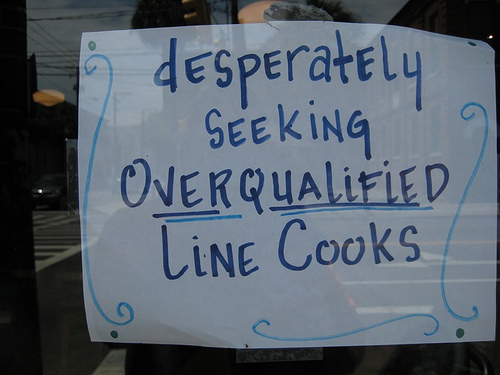
What about the idea that college graduates are being shunted into low-wage jobs that “don’t require a degree?”   In truth college graduates hold only a tiny percentage of the jobs for which a college education is overkill. College-trained workers account for only 7% of the total number of cashiers and hairdressers for example.  It is simply not true that the nation’s colleges and universities are producing overqualified line cooks.

Remarkably, even in those cases where a low skill job is held by a college graduate, a bachelor’s degree results in a “wage premium” for workers. On the average, college-educated hairdressers earn nearly 70% more than their high-school graduate workmates.  Retail sales clerks fare even better:  the 18% of  the retail sales personnel who have college degrees earn 73.2% more than someone who has only a high school diploma.  It is a wage premium that grows to 75% for some middle skill jobs.

Carnevale and Rose also analyze income discrepancies across the entire economy, concluding that the lack of college-trained personnel to fill available positions is a cause of income inequality.  It is a problem that is compounded by the increasing selectivity of some colleges and universities.  They with increasing frequency select their freshman candidates from a narrow socioeconomic pool.  So, not only do they earn more, but they come from families with disproportionately large incomes and personal fortunes.

Arizona State president Michael Crow once laid a large chart in front of me and pointed out that “The United States has not increased capacity in higher education since 1960.”  He was right.  We need 200 more universities just to get back in the game.

Crazy claims about faculty productivity are bouncing around like ping pong balls.  Public research universities in Texas are getting more than their fair share of attention from agenda-driven politicians because their professors are not spending enough time in class.  They’ve even invented a classification system based on this one-dimensional view of academic life:

  • dodgers
  • coasters
  • Sherpa
  • pioneers
  • stars

I don’t think I’d want to be a coaster, but to be honest, I wouldn’t want to be a Sherpa, either.

CCAP’s Richard Vedder has looked at the same data through a conservative economic lens and concluded that significant costs savings can be found by adjusting teaching loads — upwards, of course. Like CCAP I think there needs to be more emphasis on undergraduates, but just lopping off a part of an institutional mission is not the way to do it.  Unless, of course, you are of the opinion that everything outside the classroom is overrated in American universities.

Maybe I travel in different circles, but the faculty workday appears to me to be an already overstuffed suitcase.  Anyone who wants to cram in another sock needs to take a look at what’s already there. Mission creep, bureaucratic bloat, crushing compliance requirements, and the willful bliss with which research universities give away research time have filled every nook and cranny.

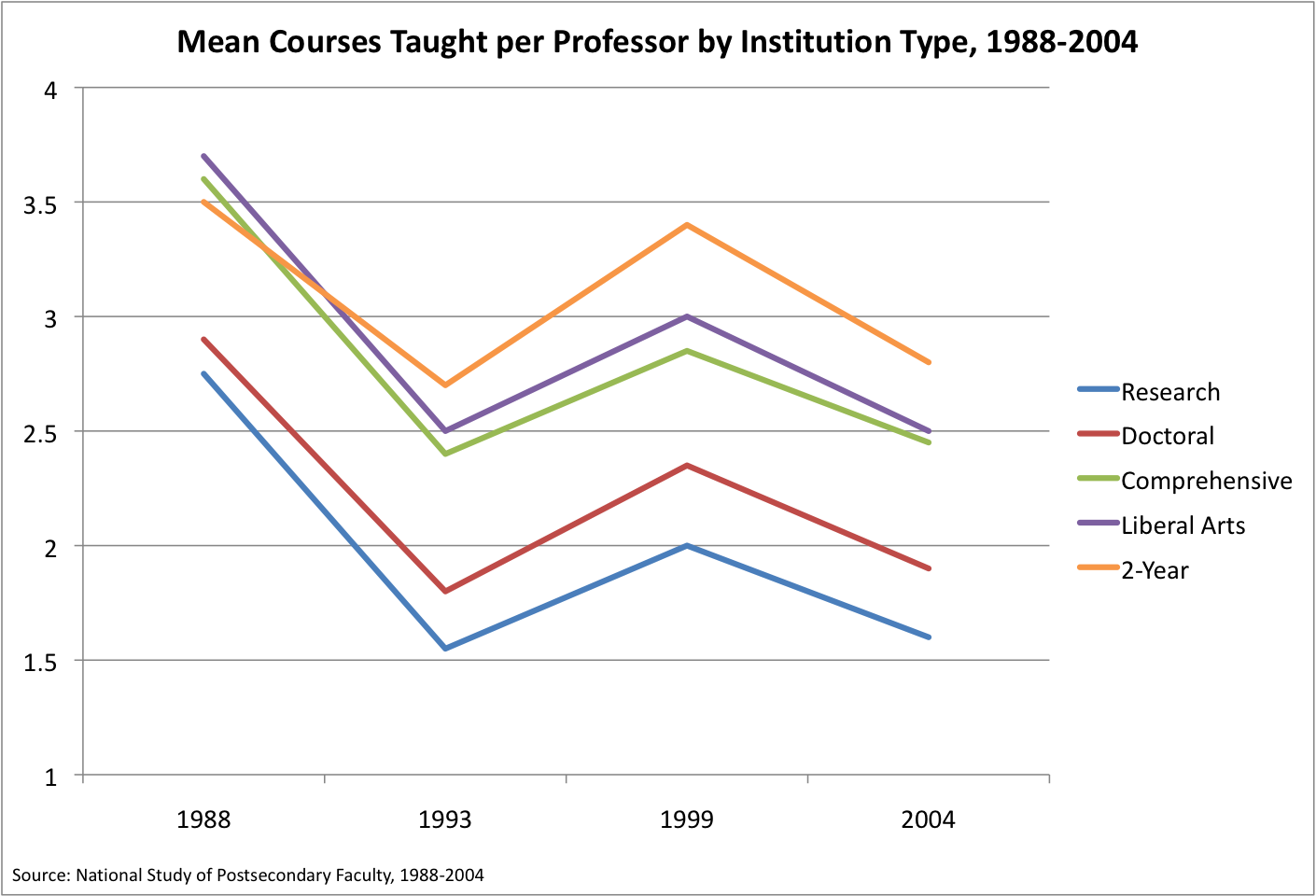
I talked a few weeks ago about how research is given away, and it’s a topic that always draws phone calls and email.  But let’s take a look at the same data that CCAP uses.  The John William Pope Center recently published a national analysis of teaching loads.  It should come as no surprise that they have gone down over the last twenty years, but more interesting is the trend.

The decreases virtually track the increased workload by program officers at Federal funding agencies. But since staff spending at agencies like NSF has been stagnant for twenty years, program officer workloads really just measure proposal submissions.

Why the decrease at Carnegie Research and Doctoral institutions?  According to an NSF study the tendency in most NSF program offices is to deliberately underfund project proposals.  Over half of the researchers surveyed reported that their budgets had been cut by 5% or more and that their grant duration had been slashed by 10% or more.  There is little room for padding an NSF budget, so these are real cuts in funds that are needed to successfully complete a research plan. One more sock stuffed into the productivity suitcase.

What does a winning proposal cost?  The same study reported:

…PIs’ estimate of the time it took for them and other people—for example,
graduate assistants, budget administrators, and secretaries (not including time spent by
institutional personnel)—to prepare their FY 2001 NSF grant submission was, on average, 157
hours, or about 19.5 days. It should be noted this is the time for just one proposal that was
successful.

Since the NSF success rate is currently around 25%, that’s about 80 days just to prepare a winning proposal.  Add to that the time needed to conduct the research that goes into every proposal submission, and you get a rough idea of what needs to be funded just to make research pay for itself.  This is lost productivity, and it shows up in reduced faculty teaching loads.

The trends at Comprehensive, Liberal Arts, and Community Colleges measure something slightly different: each of these institutions sees climbing the Carnegie hierarchy as important to their missions.  For example, NSF awarded $350M to community colleges last year.  The lions’ share of these funds went to worthy projects to train technicians, broaden participation in the sciences and support research experiences for returning veterans.  Individual awards for some of these programs start at $200,000 and solicitations for larger, center-scale proposals are encouraged. Like their research cousins, Community Colleges reduce classroom productivity to compete for federal research awards. An institution with an undergraduate research mission can easily get drawn into a system they cannot afford. And the data supports the claim.  For the period covered by the Pope Center report, proposal submissions from these institutions have increased almost in lockstep with lost classroom productivity.

Measuring technical productivity is not a job for the faint of heart. You have to take into account all uses of time, and outcomes that are often unpredictable events influenced by factors beyond an organization’s control. Modeling productivity is complex and frequently contentious, but I have yet to find anyone who seriously proposes measuring engineering productivity by the amount of time spent at a single activity.  Outside higher ed.

There is an easier explanation for the disturbing downward trend in teaching loads. It is mission creep.  There is really only one way out, and it has nothing to do with cramming more into a Texas-sized suitcase.  How about if everything from sponsored research to intercollegiate athletics had to pay its own way?  The academic suitcase is full of stuff already.  Let’s figure out where to put everything else one sock at a time.

Normally collegial discussions took a nasty turn after I suggested that most universities lose money on sponsored research.

Incredulous: “I don’t believe it. My department tacks a 50% surcharge to all my contracts; how can they lose money?”

Defensive: “Here are all the reasons that doing research is a good thing, so what’s your point?

Defensive with an edge: “Why are you attacking research?

Let’s be be clear about it:  if it’s your institution’s mission to conduct research, then spending money on research makes perfect sense.  In fact, it would be irresponsible to deliberately starve a critical institutional objective like research.

On the other hand, there are not all that many universities with an explicit research mission.  But there is an accelerating trend among  primarily bachelor’s and master’s universities to become — as I recently saw proclaimed in a paid ad — the next great research university. The university that paid for the ad has absolutely no chance to become the next great research university.  Taxpayers are not asking for it.  Faculty are not interested. Students and parents don’t get it either.

The administration and trustees think it’s a great idea.  Research universities  are wealthy.  Scientific research requires new facilities and more faculty members.  Research attracts better students. Best of all, federal dollars are used to underwrite new and ambitious goals. Goals that would be out of reach as state funding shrinks. As often as not, the desire to mount a major research program is driven by a mistaken belief that sponsored research income can make up for shrinking budgets. It’s a deliberate and unfair confounding of scholarship and sponsored research

If your university is pushing you to write grant proposals to generate operating funds, then alarm bells should be going off.  Scholarship does not require sponsored research. Chasing research grants is a money-losing proposition that can  rob funds from academic programs.  It’s an important part of the mission of a research university, but for almost everyone else, it’s a bad idea.  It’s a little like shopping on Rodeo Drive:  there’s nothing there that you need, and if you have to ask how much it costs, you can’t afford it.

How is it possible to lose money on sponsored research?  After all, professor salaries are already paid for.  The university recovers indirect costs. Graduate and undergraduate students work cheap.

A better question is how can anyone at all can possibly make money on sponsored research. Many companies try, but few succeed.  A company that makes its living chasing government contracts might charge its sponsors at a rate that is 2-3 times actual salaries. Even at those rates, it is a rare contractor that manages to make any money at all.

On the other hand, a typical university strains to charge twice direct labor costs.  Many fail at that, but the underlying cost structure — the real costs — of commercial and academic research organizations are basically identical.  There is a widespread  but absolutely false assumption that underlying academic research costs are lower  because universities have all those smart professors just waiting to charge their time to government contracts. The gap between what universities charge and what sponsors are willing to pay commercial outfits is the difference between making a profit and losing a lot of money. Just like intercollegiate athletics, sponsored research programs tend to lose money by the fistful.

Let me say up front that the data to support this conclusion are not easy to come by.  Accounting is opaque. Sponsors know a lot about what they spend, but relatively little about what their contractors spend.  It is in nobody’s interest to make the whole system transparent.  But my conversations with senior research officers at well-respected research universities, paint a remarkably consistent picture.  With very few exceptions, it takes $2.50 to bring in every dollar of research funding.

Fortunately, the arithmetic is easy to do.  If you know the right questions to ask, you can find out how much sponsored research is costing your institution. Here are ten sure-fire ways to lose money on sponsored research. You do not need all of them to get to a negative 2.5:1 margin.  If you are clever just a couple will get you there.

  1. Reduce senior personnel productivity by 50%: university budgets are by and large determined by teaching loads, a measure of productivity. It is common to adjust the teaching loads of research-active faculty. Sometimes normal teaching loads are reduced by 50% or more.  It is, some argue, table stakes, but a reduced teaching load is time donated to sponsored research because funding agencies rarely compensate universities for academic year support.
  2. Hire extra help to make up for lost productivity: Courses still have to be offered, so departments hire adjuncts and part-time faculty.
  3. Do not build Cost of Sales  into the contract price: The sales cycle for even routine proposals can be  months or years.  Time spent in proposal development converts to revenue at an extraordinarily small rate. In nontechnical fields and the humanities where research support is rare, the likelihood of a winning proposal is essentially zero.
  4. Engage in profligate spending to hire promising stars: Hiring packages for highly sought-after faculty members can easily reach many millions of dollars.  A sort of hiring bonus, there is little evidence that this kind of up-front investment is ever justified on financial grounds.
  5. Make unsolicited offers to share costs: Explicit cost-sharing requirements were eliminated years ago at most federal agencies.  Nevertheless, grant and contract proposals still offer to pay part of the cost of carrying out a project.
  6. Allow sponsors to opt-out of paying the indirect  cost of research: An increasingly common practice is to sponsor a research project with a “gift” to the university.  Gifts are not generally subject to overhead cost recovery, so a university that agrees to such an arrangement has implicitly decided to subsidize legal, management, utility, communication, and other expenses, and
  7. Accept the argument that indirect costs are too high: The  meme among federal and industrial sponsors is that indirect costs are gold-plating that must be limited. Rather than believe their own accounting of actual costs of conducting research, they argue that universities, should limit how much they charge back to the sponsor.
  8. Build a new laboratory to house a future project: Sponsors argue that it is the university’s responsibility to have competitive facilities.  But that new building is paid for with endowment funds or scarce state building allocations that might have gone toward new classrooms or upgraded teaching labs.
  9. Offer to charge what you think the sponsor will pay, not what the research will cost:  Money is so tight at some funding agencies that program managers are told to set a (small) limit on the size of grants and proposals independent of the work that will be actually be required.
  10. Defray some of the management costs of the sponsoring agency: It has become so common that it is hardly noticed.  University researchers troop into badly-lit conference rooms to help program officers “make the case” to their management.
The list goes on. It is so easy to turn a sponsored research contract into a long-term commitment to spend money for which there is no conceivable offsetting income stream that institutions routinely chop up the costs and distribute them to dozens of interlocking administrative units.  The explosion in the number of research institutions has all the elements of an economic bubble.
  • It is motivated by a gauzy notion that all colleges and universities are entitled to federal research funds..
  • It is fed in the early stages by accounting practices that make it easy to subsidize large expenditures.
  • It has the cooperation of funding agencies who know that the rate of growth is not sustainable.

Virtually everyone involved in university research knows that the bubble will burst.  A colleague just showed me an email from his program director at a large federal research agency.  It said that — regardless of what he proposed — the agency was going to impose a fixed dollar amount limit on the size of its grants. But in order to win a grant, he had to promise to do more.  His solution: promise to do the impossible in two years instead of three.  Just like the famous Sydney Harris cartoon,  a miracle is required after two years. At least there would be enough money to pay the bills while a new grant proposal was being written.

Awhile ago, I mentioned India’s plan to create 27,000 new colleges and universities over the next decade.  Well, guess what?  I was wrong.  The number is now 35,600. Here’s what I said a year ago about Education Minister Sibal’s plan to expand India’s capacity in higher education:

What does this have to do with American colleges and universities? Just as low-cost, high value service industries have migrated to India, the higher education market in the US will also start to buy more educational services there as well.

So I was immediately drawn to yesterday’s Business Week article about California’s intention to make a quick lunch of its seed corn by cutting university spending $1.4B and the likely effect that snack will have on job growth and tax revenue.

Particularly striking to me was VC Robert Ackerman’s reaction to the massive and rapid expansion of higher education in Asia:

Right now, if I were the Chinese university system, I’d be running ads showing up on UC websites, recruiting students to universities in Beijing and Shanghai.

Now I am not a big fan of the proposition that value in higher education can be measured in dollars spent–if American institutions made better use of their budgets, then the resulting efficiencies would actually increase capacity–but there is little doubt that wholesale dismantling of universities across the country is a very bad idea.

We are shrinking university capacity at a time when India, China, Singapore and many other countries are  increasing theirs. India  alone will create 600 new research universities. China is increasing its capacity in research universities while the  U.S. has created one new research university this century: UC Merced.  Since Merced is part of the California system, its prospects are dimmer by the moment. Only a handful of new universities of any kind have been created in the U.S. since 1960, a period in which college enrollments have quadrupled.

Why is falling capacity so important? Because the worldwide market is growing, and we are systematically reducing our share of that market when economic competitors are  moving in the opposite direction. I leave it as  a homework exercise to determine what happens when an enterprise loses market share in a growing market.

Buon appetito!