
Archive

Policy

Sometime last year — exactly when depends on whose data you rely upon — the debt total of American college students topped a trillion dollars, surpassing credit cards, second only to home mortgages as the major source of indebtedness for students and families.

The principle reason that students are taking on debt is a dramatic rise in the cost of attending college. I have used this chart on other occasions,  but it is still the most dramatic illustration of what has  happened to  college tuition over the last twenty years.
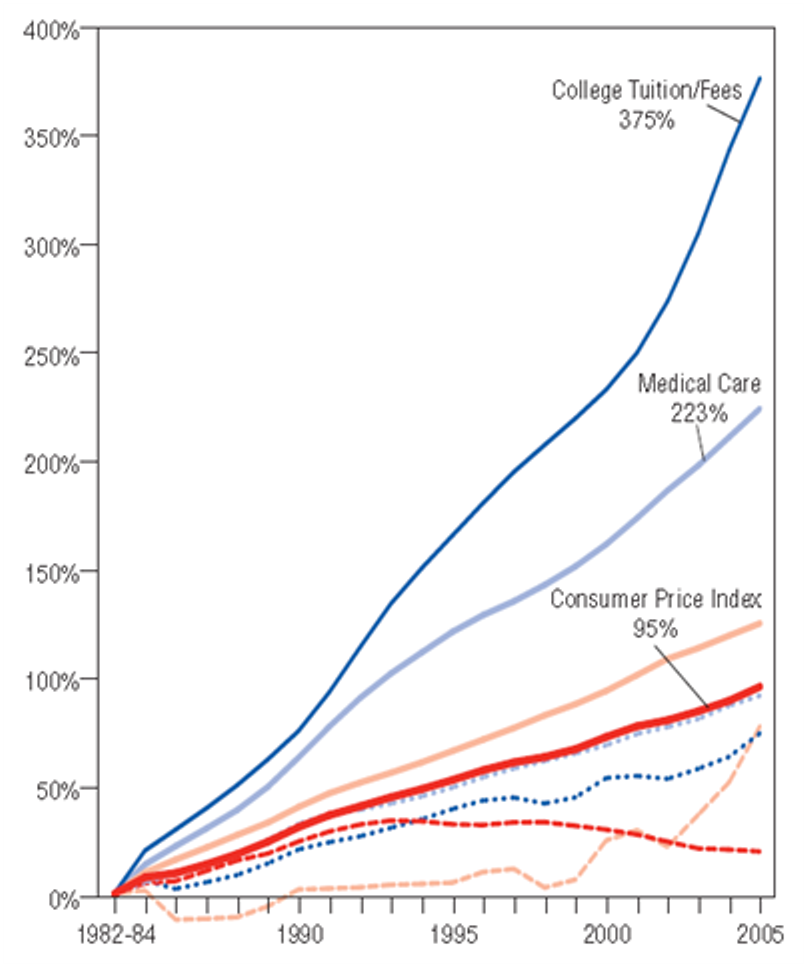
This chart stops at 2005.  From 2005 to 2012, tuition has risen at an annualized rate of 8%. It is a breathtaking climb, and it means that students (and their families) are turning to student loans in unsustainable numbers.

None of this is news.  It is fodder for cable TV talk shows, Presidential campaign speeches, and a considerable number of faux populist attacks on the very idea of a college degree. The Obama administration has even weighed in with a Race to the Top for Colleges initiative that focuses to a large measure on affordability.

Conservatives say that it is the ready availability Federally backed loans that a driving cost increases.  Progressives –including many who support the Occupy Wall Street movement — say that that a the same cultural factors that drove banking abuses are also driving the disparity between who can afford a college education and who can not.

There is little evidence that either statement is true and considerable evidence that neither are. I will return to this subject in a later post.

The first thing to understand about the rise in college costs is the difference between the cost of running a university — the spending side of the equation —  and the price paid by students. In higher education there are all kinds of prices.  There is the advertised or sticker price, which is what it sounds like. But sticker prices can be discounted, and there are also wholesale and retail prices.

For-profits aside, you would think that there would be a straightforward relationship between costs and prices since, after all, the name of the budget game in a university is to take in just enough revenue to offset the costs of operating programs and facilities.You would think, for example, that costs were simply passed along to students in the form of tuition and fees, which are components of the revenue side.

If that were true then rising tuition would be a result of rising costs.  Some costs, like healthcare, have risen dramatically, but the rise in tuition is for the most part unrelated to increased operational costs.

College costs are high and have been high for at least a hundred years. When Harvard President Charles Elliot began  to dismantle the university’s rigid core curriculum — replacing it with an elective system — in the late 19th century, he grew the size of Harvard’s faculty tenfold. It was a shock to Harvard’s carefully tuned financial model, but it led to even more dramatic growth in private giving, creating a sustainable system in which endowed funds are used to offset variable costs of operation.

Labor alone accounts for much of the variable cost of running a university.  That means, as James Surowiecki, pointed out in his recent New Yorker article:

In other words, teachers today aren’t any more productive than they were in 1980. The problem is that colleges can’t pay 1980 salaries, and the only way they can pay 2011 salaries is by raising prices

That, however, does not really explain why tuition has risen so dramatically. Faculty salaries have been stagnant for almost a decade. Furthermore, when measured as cost per degree awarded, universities are actually just as productive today as they were in 2005.

As Surowieki points out the “arms race” that causes universities to invest in bling could explain some of the increase, except that the rate of increase in those expenditures have been flat,  too. In fact spending in general has been flat.

So what’s going on?  Have universities been pocketing the difference between what it takes to run an academic program and what students are willing to pay? The only players in the higher ed game that have the ability to do that are the For-Profits and their 3.2%  tuition increases have been the lowest among all types of institutions.

This post begins a series that over the next couple of weeks tries to answer the “What’s going on?” question.  Part primer and part road map, the series continues next week with some of the facts you think you know about college tuition that are in reality not true.
Next: Three Myths about Rising College Costs

This has been a bad year for intercollegiate athletics what with the Penn State scandal and the unpleasant glare of publicity that has reflected onto big-time, big money sports.  In today’s commentary section of The John William Pope Center for Higher Education, I write about the ringers and rogues who help maintain the Knute Rockne All American fiction of college sports.

The interests of the academic and athletic programs in most Division I and many Division II schools are not aligned.  I propose a legislative solution: a “firewall” that separates the two:

What is needed to save intercollegiate athletics is a Glass-Steagall Act for universities… It gets universities out of the sports entertainment business—a very good idea.

The last time I checked on the financial health of colleges and universities the news was not good: in 2010 the finances at 150 private nonprofits were so fragile that they failed the Education Department’s test of financial responsibility.  The Feds provide financial aid to students who attend responsibly managed educational  institutions, so it’s not unreasonable for them to ask whether audited financial returns reflect sound management. The 2011 test results were released in late October.

What does it take to pass the test? The ability to meet current and projected debt obligations is a factor, but the heart of the test is a numerical score: DOE looks at a weighted composite of  three ratios:

  1. Primary reserves: Ratio of adjusted equity to total expenses, a basic measure of liquidity
  2. Equity: Ratio of modified equity to modified expenses, an indication of an institution’s ability to borrow (modifications include things like one-time charges, allowances and extraordinary events)
  3. Net Income: Ratio of  before-tax income to total revenues, a  basic measure of profitabilty (incongruous for a non-profit but even the purest non-profit institutions do not like to deplete their cash positions)

A composite score of 1.5-3.0 indicates healthy finances. 1.5 is a passing grade.  Anything  less than 1.5 is not a passing grade.

A  score in the range of 1.0 to 1.4 — which DOE calls the zone — indicates a need for additional oversight.  This is a sore point with colleges– many of which would howl to high heaven if a Wall Street bank raised the same objection — who decry the bureaucratic heavy-handedness of a federal agency that would want to impose a modicum of accountability.

Anything below 0.9 is a failing score, and to continue receiving Federal Student Aid, a failing institution must supply additional letters of credit.

More than 180 private non-profits scored below 1.5 and 56% of those scored below 1.0.  A complete spreadsheet can be found here. Mind you, this is not the ragtag collection of colleges of cosmetology that populate the for-profit component of the DOE report. I’ve stripped those out of the spreadsheet. They are in awful shape too, but federal student aid to a future hair stylist never made much sense to begin with.  More on this in a later post.

No, the non-profits tested by the Department of Education are mainly liberal arts colleges, schools of design, independent schools of medicine and law, and denominational institutions (many with important historical roots).  They are in many ways the same schools whose free-wheeling approach to financial management gave John D. Rockefeller and Andrew Carnegie fits when they established the first philanthropic foundations to support higher education in the early 1900s.

By FY 2010 the stock market had begun to recover and endowments had started  to regain some of their lost value. The expectation was that the DOE scores would reflect an improving fiscal outlook for the nation’s private institutions. That obviously did not occur.

In most circumstances, these numbers would need no further elaboration.  In fact, news of the dismal  2011 report appeared  in Inside Higher Education and The Chronicle of Higher Education back in October. It was a press release issued by the National Association of Independent Colleges and Universities (NAICU) that caught my eye and raised my blood pressure. It said in part:

It must be noted that the list is under increased scrutiny by accounting experts who believe [federal] financial analysts are not always using the right accounting definitions.

and

The overwhelming majority of institutions that have appeared on the list in previous years continue to provide a quality education to their students.

I other words, despite the continued price inflation needed to prop up badly managed institutional priorities — and despite the mounting evidence that a many of these institutions are simply not delivering value to their students at the inflated prices —  the NAICU position seems to be that it’s the definitions that should be blamed.  If you’ve read this blog before or if you’ve scanned my book, you know that I can’t let this pass without comment.

There is a lot of complaining in the ranks of private non-profits about the accuracy of the test, but it is hardly a secret that there is something wrong with your business model  if the only way you can continue to operate is to continually and without warning raise prices to locked-in customers who are  (1) resigned to take on crushing debt or (2) eligible for unbounded federal, state and local subsidies to offset price increases.

How different would the picture have looked if construction of a few of those new dorms or fancy student centers had been delayed or an invitation to a money-losing post-season tournament had been declined? Would fiscal health have improved if administrative offices had shed some of their bloated staff? Might instructional costs have been held in check if clusters of small institutions had merged some of their general education requirements and created cost-efficient teaching pools for introductory English, history, and math courses?

Yes, the majority of the failing institutions probably do continue to provide a quality education to their students. But at what cost?

The Joint Commission Education Subcommittee is a strategic science and technology initiative of the Georgia Senate and General Assembly that seeks to chart the tech legislative and policy direction for the state of Georgia.  A copy of the resolution can be found here.

The subcommittee met at Georgia Tech on October 18 to discuss the role of STEM education in meeting Georgia’s growth aspirations in science and technology.

I organized my recommendation to the subcommittee around three principles:

  1. The role of technology
  2. The role of teams
  3. Do not miss opportunities

Here is a transcript of my remarks:

SR28 Committee Remarks

#change11