
Author Rich DeMillo discusses the high-delinquency rate of student loans and how it will impact higher education with Fox Business Network host Stuart Varney.

Author Rich DeMillo discusses the high-delinquency rate of student loans and how it will impact higher education with Fox Business Network host Stuart Varney.

The Joint Commission Education Subcommittee is a strategic science and technology initiative of the Georgia Senate and General Assembly that seeks to chart the tech legislative and policy direction for the state of Georgia. A copy of the resolution can be found here.
The subcommittee met at Georgia Tech on October 18 to discuss the role of STEM education in meeting Georgia’s growth aspirations in science and technology.
I organized my recommendation to the subcommittee around three principles:
Here is a transcript of my remarks:
#change11
There was a time before TSA and 9/11 when crazy people wandered freely around the nation’s airports. I was heading to the Eastern Airlines gates at O’Hare when I was stopped by a guy in a suit wearing a sign that said there was now mathematical proof that the country was going to Hell in a hand-basket. I slowed a beat but it was enough for him to shove a magazine in my hand. “You should read this!” he said. “They don’t want you to know about it!.” I glanced at the cover. It was Fidelio, Lyndon Larouche’s magazine of culture and science. “Great,” I thought. “NCLC propaganda.”
I was ready to bolt for the Eastern passenger lounge, when the guy tugged the magazine from my hand and flipped it open to a Larouche rant about Georg Cantor and transfinite numbers. My next mistake was to say something like, “Well, this is a load of crap.” I had taught set theory and for a brief instant I imagined that I could waste a little time toying with the guy before pounding him to intellectual pulp. It was the opening he was looking for.
I was hopelessly over matched. Never mind that I knew that he had no idea what he was talking about. Norbert Weiner, the Reimann Hypothesis, Plato, and negative entropy and were all smashed together, mixed and reshaped as a serious critique of western political economy. He was getting louder and more aggressive, so I grabbed my bags and headed down the concourse at full speed with this guy and his sign chasing after me yelling in a vaguely threatening way.
I can’t stay away from encounters like that. I have had other run-ins with zealots who are shameless about misquoting, misapplying, and misappropriating stuff that I happen to know something about. I want to unmask them in public. Show them for the frauds they are. I tell you this story to prepare you for my comments about the worst abuse of a deep and very important idea that I’ve seen in a long time. It may end badly, but I can’t stay away.
My attention was drawn to a recent CCAP post about unnecessary cost escalation in higher ed by Andrew Gillen who is inspired by Charles Babbage to suggest that there be a “division of labor” in which the job of lecturing is separated from the job of grading. The result according to Mr. Gillen would be a 30% reduction in costs that can be passed along to students in the form of tuition reductions.
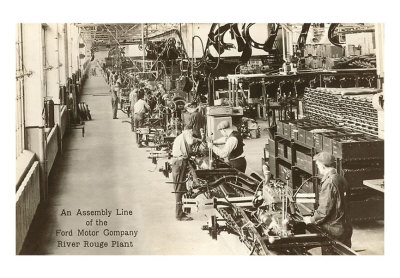
I am a computer scientist, so Charles Babbage is intellectually speaking a friend of mine, the originator of the very concept of a computer. Nobody knew how to mechanize better than Charles Babbage. His book, On the Economy of Machinery and Manufactures, is aimed at the upwardly mobile assembly line workers of 19th century England. It is an explanation of manufacturing economics for the common man.
In 1850 London’s mills and factories were houses of horror:
Any man who has stood at twelve o’clock at the single narrow door-way, which serves as the place of exit for the hands employed in the great cotton-mills, must acknowledge, that an uglier set of men and women, of boys and girls, taking them in the mass, it would be impossible to congregate in a smaller compass.[P. Gaskell, The Manufacturing Population of England. London, 1833, pp.161-162]
I won’t recount all of Babbage’s arguments beyond saying that the mechanization of, say, the production of sewing needles–in which the dangerous and expensive alignment of parcels of metal so that the ends can be sharpened before they are separated can be done more cheaply by a primitive robot–has virtually nothing to do with the craft of being a university professor. Yet here is what Mr. Gillen takes away from the Babbage text:
In higher ed, we need high [sic] skilled people for some aspects of the job (designing courses, creating assessments, mentoring, etc.) but many of the other tasks they perform don’t require as much skill, and could be performed much more cheaply by lower paid workers (routine grading, administrative tasks, most office hour questions, finding and dealing with cheating, even some of the teaching). And yet all tasks are performed by the most highly paid people.
Mr. Gillen is right that de-skilling is important in controlling costs. It is a problem to be solved in healthcare, government and education, but not in the way that Mr. Gillen suggests. I’ve seen this argument enough in the last few weeks to know that there might be trouble brewing, so let me restate some points that are well-known to readers of Innovate.EDU:
In fact, Gillen has it exactly backwards. The De-Skilling Argument is this: let’s take the least value-laden part of teaching out of the hands of high-priced professors. The most valuable part of teaching lies in the personal interaction of students and mentors and in the peer-to-peer interactions of learning communities. Why would anyone want to depersonalize that?
The issues raised by this notion are both legion and obvious. How would you know in advance which office hour questions were routine? Why should delegating routine administrative tasks — whatever those might be — to unskilled labor lead to savings anyway? Don’t learning management systems/course management systems purport to do the same thing already? Why would this proposal not lead to increased costs as new, unskilled workers are added to the university workforce?
It’s not a fair fight, but the CCAP proposals are sometimes the only ones out there — and they are listened to — so someone needs to shout “Well this is a load of crap!”
Now, where’s that Eastern Airlines lounge?
Last year, I posted a cautionary article about the danger of letting opponents define you. If you thought I was overwrought when I suggested that “Picking Daisies” — the campaign ad that in all likelihood sunk Barry Goldwater’s presidential ambitions–had anything to do with public support for higher education, let me encourage you to spend the next hour watching this little number. It is called “College Conspiracy,” and it has one message: “College education is the biggest scam in US history,” I have made it easy for you. Just click play.
If you doubt that political warfare is being waged and that its aim is to provoke rage– to undermine public support for colleges and universities–just sit back as the ominous music leads you to the inevitable conclusion:
There is no reason that we the taxpayer should be funding college education.
It’s available on dozens of video sharing sites, including YouTube, which reports over two million views. That number is an order of magnitude larger than the number of copies of all books about how to improve higher education published in the last decade. Two million enraged viewers is enough to sway votes. It’s enough to pressure legislators. It is a large number.
There are close-ups of distraught faces and stories of foul greed:
Education ruined my life!
The camera shifts to the sympathetic interviewer:
They’re just vultures.
A clearly knowledgeable and steely-eyed commentator says that you don’t need a college degree to be successful and that the escalating costs of getting one is a harbinger of hyperinflation.
The narrator, with charts and graphs, argues that, like semiconductors, prices should actually be going down. For-profit colleges and traditional institutions are all painted with the same brush. They defraud students who, in exchange for exorbitant fees, end up with a worthless piece of paper that qualifies them for exactly the same low-paying jobs that high school graduates hold. Despite the Georgetown data showing that we have too few universities, steely-eyed commentator says that we have far too many.
You can pack a lot of disinformation into an hour. It took just thirty seconds to sink Goldwater. The problem is that “College Conspiracy” intermingles facts with distortions and tortured logic.
What nobody is told, for example, is that universities like the University of Chicago have reconstructed their approach to college football to make sure that it supports the academic mission. Or that a college education can be worth a lot to a student who studies at the right school and majors in the right subject. It doesn’t matter. Two million times, a story with elements of truth beat like a drum the message that higher education is not worthy of public support. What do we say?
Here is how I answered that question last year:
How do American universities respond? Meekly. As reported in the Chronicle of Higher Education, university leadership has been slow to recognize the direction and force of prevailing winds. A common mistake in business and politics is to focus on the feel-good stuff that is ultimately valueless, and universities are making the same mistake. The Chronicle reports that former MIT vice president John Curry told a gathering of heads of public universities to stop clinging to “worn out myths about campus strengths.” Curry told the group, “We like our stories more than the truth.” That leaves a vacuum for others to tell their versions of the truth. It was devastating to Goldwater and it will be devastating to higher education.
Facing the truth is an important part of focusing on the value of a university education, and Gerard Adams–the force behind “College Conspiracy”–knows that. He is the sympathetic interviewer. He is also president of the National Inflation Association (NIA), which produces not only “College Conspiracy” but other doomsday videos predicting hyper-inflationary consequences of monetary policy, healthcare reform, and food prices. What NIA is really all about is promoted prominently on their website:
Our goal is to help as many Americans as possible become aware of the disaster we are rapidly approaching. In our opinion, the wealth of most Americans could get wiped out during the next decade, but it will be an opportunity for a small percentage of Americans to become wealthy by investing into companies that historically have prospered in an inflationary environment, such as Gold and Silver miners and Agriculture producers.
NIA is a fringe group,and their activities are under scrutiny. But two millions viewers is a lot of viewers. Add to Gerard Adams conservative economists like Richard Vedder, who says through his organization Center for College Affordability and Productivity (CACP):
The pell-mell investment in sheepskins is beginning to look an awful lot like something our economy has seen in real estate: a debt-fueled asset bubble. It might end just as badly.
CACP has a message that is capable of reaching mainstream Americans. On the September 16, 2011 edition of the NBC Nightly News with Brian Williams, Richard Vedder’s voice was the one that reached 7 million viewers. He said college was “less good” as an investment. New York Mayor Michael Bloomberg said, “College kids can’t find jobs and that could lead to riots in the streets.” And then there was an anonymous student who said to all of Brian Williams’ 7 million viewers: “College is a scam.”
Add the NIA audience to the NBC audience and you get roughly 10 million viewers. “Picking Daisies” was watched by an audience of 50 million. The Republican response was to complain about the fairness of the ads, but a week after the ad aired, a Harris poll found that half of all Americans believed that Barry Goldwater would involve the US in a nuclear war. What will be the response of higher education to “College Conspiracy”?
Others will define you if you don’t define yourself.
#change11

 Innovate.EDU